

When Chronic Illness Forced Me to Step Away From Work: Short-Term Disability With Chronic Illness

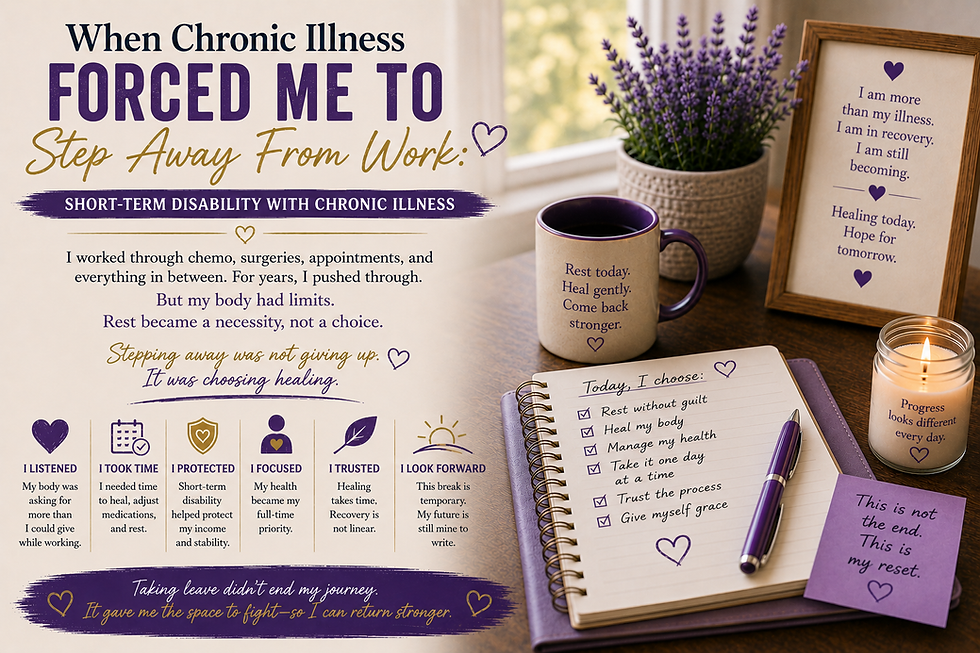
Short-Term Disability With Chronic Illness: Taking Time Away From Work
I had already worked through cancer treatment.
I had adjusted my schedule around chemotherapy, bloodwork, scans, and doctor visits. I had worked evenings and weekends to replace hours lost to medical care.
For years, I found ways to keep working while my body carried cancer treatment, medication side effects, diabetes, pain, fatigue, and other chronic illnesses.
Eventually, my body needed more than another adjusted schedule.
I needed to step away from work.
Taking short-term disability was not part of the retirement plan I had imagined. I was about two years away from the time I hoped to retire, and I wanted to reach that point on my own terms.
My health had a different timeline.
I Had Already Proven That I Could Push Through
I knew how to work while sick.
I had done it during doxorubicin chemotherapy.
When medical appointments took hours from my weekday, I made up the time later. I worked during evenings and weekends that could have been used for recovery.
I continued because I needed my paycheck, health insurance, and financial stability.
I was proud that I had kept going.
That history also made stepping away more difficult.
Part of me believed that because I had worked through chemotherapy, I should be able to keep working through almost anything.
The Body Does Not Care What I Previously Survived
Surviving one difficult period does not mean the body has unlimited strength for the next one.
Cancer treatment left lasting effects.
Long-term medicines added more.
Diabetes required careful management.
Pain, limited mobility, mental fatigue, appointments, and chronic health conditions continued using energy.
Then I had additional medical needs, including a colon procedure and the time required to recover from it. My medicines also needed adjustment while my body healed and my diabetes was brought under better control.
These were not isolated problems.
They were several demands placed on a body that had already carried years of treatment.
My Health Problems Were Beginning to Compete With My Job
A chronic condition does not always create one dramatic emergency.
It may gradually require more attention.
There may be:
* More appointments
* More laboratory work
* Medication adjustments
* Procedures
* Recovery time
* Blood-sugar monitoring
* Fatigue
* Pain
* Difficulty concentrating
* Restrictions on eating or activity
* More communication with doctors
Each item may look manageable by itself.
Together, they can consume the energy needed to work safely and consistently.
Flexible Scheduling Could No Longer Solve Everything
Flexible hours had helped me for years.
I could move an appointment to part of the workday and complete the work later.
That solution depended on having enough energy later.
When illness, procedures, medication changes, and recovery were using the rest of my day, there was nowhere left to move the work.
I could not continue borrowing hours from rest without eventually owing my body more than I could repay.
I Needed Time to Heal, Not Merely Time to Attend Appointments
There is a difference between receiving permission to go to a doctor and receiving enough time to recover.
A procedure may last only part of one day.
Preparation may begin earlier.
Healing may continue for days or weeks.
Medication changes may require monitoring before the body stabilizes.
Diabetes management may require repeated adjustments rather than one appointment that solves everything.
I did not need only a few scattered hours away from work.
I needed a period when recovery could become the main responsibility.
Taking Leave Felt Like Losing Control
I had spent years trying to keep cancer and chronic illness from controlling my professional life.
Taking short-term disability felt as though my body had made the decision for me.
I worried about:
* Losing income
* Falling behind at work
* How my absence would affect others
* Whether I would recover as expected
* Whether I could return to the same duties
* What another health problem might mean
* Whether I would reach retirement as planned
* What would happen to my benefits
* Whether people would see me differently
The leave was intended to reduce one pressure.
At first, it created new worries too.
Short-Term Disability Did Not Replace My Full Pay
During earlier surgical leaves, short-term disability replaced approximately 60 percent of my usual wages.
That support mattered.
Sixty percent was not the same as my full paycheck.
My household expenses did not fall to 60 percent.
My medical expenses did not fall to 60 percent.
The financial pressure could make returning to work too quickly feel like the responsible choice, even when the body was not ready.
Income Replacement and Job Protection Are Different
Short-term disability generally refers to an employer or insurance benefit that replaces part of an employee’s income during a qualifying period of disability. The exact percentage, waiting period, length of coverage, exclusions, and documentation requirements depend on the plan.
The federal Family and Medical Leave Act is different. For eligible employees of covered employers, FMLA can provide unpaid, job-protected leave for qualifying medical and family reasons while continuing group health benefits under the same conditions. It may also permit intermittent or reduced-schedule leave when medically necessary.
A person may use different benefits or protections at the same time, depending on eligibility and the employer’s policies.
I had to understand which program replaced income, which protected my job, and what paperwork each one required.
Medical Leave Creates Its Own Administrative Work
Becoming too sick to work does not remove paperwork.
It can create more of it.
There may be:
* Employee forms
* Healthcare-provider certification
* Medical records
* Estimated recovery dates
* Return-to-work forms
* Benefit-company calls
* Employer communication
* Updated restrictions
* Requests for additional documentation
* Deadlines
* Recertification
An employer may require medical certification supporting the need for FMLA leave. For intermittent or reduced-schedule leave, the certification may need to estimate the frequency, duration, and medical necessity of the absences.
The person who needs time to recover is still expected to coordinate the documentation proving that recovery is necessary.
I Had to Explain What My Body Could Not Do
A diagnosis alone does not always show how a person’s ability to work is affected.
The medical documentation may need to describe limitations such as:
* Inability to work a full schedule
* Need for recovery after a procedure
* Frequent or unpredictable medical appointments
* Medication effects
* Severe fatigue
* Pain or mobility limitations
* Difficulty concentrating
* Need for breaks
* Restrictions on lifting, standing, sitting, or driving
The goal is not to share every private detail with everyone at work.
It is to provide enough appropriate information for the leave or accommodation process.
Cancer Was Not the Only Health Problem Anymore
People may hear that I am a cancer survivor and assume every leave request must be directly caused by active cancer.
My medical life had become more complicated.
Cancer treatment contributed to a long-term chain of health needs.
I was also dealing with diabetes, medication effects, procedures, pain, cardiovascular monitoring, mobility limitations, and other chronic conditions.
A body does not separate those problems into neat categories.
The fatigue from one condition affects the ability to manage another.
A procedure affects blood sugar.
A medication change affects energy.
Stress affects concentration and sleep.
My need for leave came from the total health picture.
The Colon Procedure Required Real Recovery
A colon procedure or surgery is not only an appointment placed between two work meetings.
There may be preparation, dietary changes, anesthesia, discomfort, restrictions, pathology results, follow-up, and healing.
My body needed time to recover.
I also needed to see how my diabetes and medicines responded during that period.
Trying to return to full work before those issues stabilized could have created another setback.
I had to stop measuring recovery by how soon I could log into a computer.
Working From Home Is Still Working
A person may assume that a desk job or remote job can always be performed during recovery.
Working from home can remove commuting and reduce physical demands.
It still requires:
* Concentration
* Memory
* Judgment
* Communication
* Sitting or positioning
* Reliable availability
* Meeting deadlines
* Managing stress
A person can be physically at home and still be medically unable to perform essential duties.
The location of the computer does not determine whether the body is ready.
Rest Needed to Become the Assignment
During cancer treatment, I often treated rest as what happened after every other responsibility was finished.
On disability leave, recovery needed to move to the top of the list.
That meant allowing time for:
* Sleep
* Healing
* Medical appointments
* Blood-sugar management
* Medicine adjustments
* Nutrition
* Gentle movement when appropriate
* Emotional recovery
* Follow-up testing
Rest was no longer the leftover portion of the day.
It was part of the medical plan.
I Still Felt Pressure to Be Productive
Being home did not automatically quiet the part of me that wanted to accomplish something.
I could see household projects.
I could think about writing.
I could notice unfinished tasks.
I could focus on something irritating me in the house and feel tempted to use the day fixing it.
I had to remind myself that being on medical leave did not mean I had been given vacation time for household productivity.
If I used all my energy cleaning, organizing, or working on projects, I was not giving my body the recovery time the leave was intended to provide.
A Good Day Could Create False Confidence
Chronic illness is not always consistent.
I could have a better day and think:
“I am ready to return.”
Then the next day could bring fatigue, pain, blood-sugar problems, or another medical issue.
A single good day did not necessarily show that I could sustain a full workweek.
Returning required thinking about consistency.
Could I work day after day?
Could I complete my duties without using every evening and weekend to recover?
Could I attend necessary appointments without destabilizing the whole schedule?
Recovery Is Not Always a Straight Line
Healing can include better days and setbacks.
A medicine may need to be adjusted more than once.
A procedure may heal well while another condition remains difficult.
Blood sugar may improve gradually rather than immediately.
Energy may return in small amounts.
A projected return date is an estimate based on the information available at that time.
The body may not follow the paperwork perfectly.
I Was Thinking About Retirement
Being about two years from retirement made every work decision feel larger.
I had already spent decades working.
I had managed careers, family responsibilities, divorce, cancer, chronic illness, and financial pressure.
I wanted to reach retirement with stability.
I wanted to choose when I stopped working.
Medical leave reminded me that health could affect the plan before I was ready.
Retirement Was More Than Leaving a Job
Retirement represented:
* Financial security
* Time for writing
* More control over medical appointments
* Opportunities to travel
* Time with grandchildren
* Less pressure to work through illness
* Freedom to build Surviving Life Lessons
* A different pace of life
The possibility that chronic illness could interrupt the final working years felt unfair.
I had worked hard to reach that stage.
I wanted the chance to finish.
I Had to Separate the Plan From My Worth
My retirement plan mattered.
It did not determine my value.
If my body required a different timeline, that would not erase the years I worked or the responsibilities I carried.
I was not a failure because illness affected employment.
I was not less hardworking because I finally needed more recovery than a flexible schedule could provide.
My work history remained true even if the ending changed.
## Returning Too Soon Could Threaten the Larger Goal
The desire to protect income and reach retirement could tempt me to return before I was medically ready.
That might lead to:
* Another medical setback
* More leave
* Poor work performance
* Unsafe decisions
* Worsening symptoms
* Increased stress
* A longer recovery overall
Sometimes protecting the ability to work longer requires taking enough time away now.
That is difficult to accept when each reduced paycheck creates pressure.
I Needed Honest Medical Guidance
A return-to-work decision should not be based only on guilt, fear, or one better day.
I needed to discuss:
* Whether healing was adequate
* Whether blood sugar was stable enough
* Whether medication effects were manageable
* Whether I could concentrate consistently
* Whether physical restrictions remained
* Whether a gradual return was appropriate
* Whether accommodations were needed
* What symptoms would require another pause
The doctor understood the medical condition.
I needed to explain the real demands of my job.
A Gradual Return May Be Different From Full Readiness
Some employees may be able to return with temporary adjustments.
Depending on the job and circumstances, possible accommodations may include:
* Reduced hours
* A gradual return
* Remote work
* Additional breaks
* A flexible start time
* Time for appointments
* Temporary physical restrictions
* Reassignment of nonessential duties
* Intermittent leave
The ADA may require covered employers to provide reasonable accommodations to qualified employees with disabilities unless the accommodation would create an undue hardship. Leave, schedule adjustments, periodic breaks, and remote work may be considered in appropriate circumstances.
The correct arrangement depends on the person and the essential duties of the job.
An Accommodation Is Not a Promise of Less Work Forever
A reasonable accommodation changes how work is performed or removes a workplace barrier.
It does not automatically require an employer to remove essential job functions or accept lower-quality work.
That distinction matters.
I wanted support that allowed me to perform the job safely.
I did not want people to assume I no longer cared about the quality of my work.
I Had to Consider the Cost of Returning
Returning to work would restore more income and routine.
It would also use energy.
I needed to consider whether I could manage:
* Work hours
* Medical appointments
* Meal preparation
* Blood-sugar tracking
* Medicines
* Household needs
* Rest
* Unexpected medical problems
The question was not only whether I could get through the first workday.
It was whether I could sustain the full life surrounding the job.
The Household Still Needed Attention
Medical leave did not stop dishes, laundry, bills, groceries, or repairs.
I had already learned to reduce household stress by preparing meals, batching appointments, organizing medical information, and occasionally paying for outside help.
Those strategies became even more important during recovery.
The goal was to preserve energy for healing rather than spend it all maintaining the house exactly as I once had.
I Needed to Accept Outside Help
If I could pay someone a modest amount to clean a wall, complete a repair, or handle another irritating task, I considered doing it.
That protected my body.
It also protected my relationship with my son.
He needed to continue working and helping with the things that mattered most.
Every household task did not need to become his responsibility simply because I was recovering.
Organization Reduced Leave-Related Stress
My Ultimate Chronic Illness Tracker helped me keep the numbers my doctors wanted.
I could record blood sugar, blood pressure, symptoms, medicines, and other information.
That made appointments more useful.
It also reduced the stress of trying to remember everything while answering questions about whether I was ready to return to work.
Clear information helped me describe what was improving and what still required attention.
Medical Leave Did Not Remove Work Stress Immediately
Even while away, I could think about work.
What was happening without me?
Was someone covering my responsibilities?
Would I return to a backlog?
Would systems change?
Would people assume I was not coming back?
It took time to understand that I could not recover fully while mentally performing the job every day from home.
I needed boundaries around work communication.
Staying Connected Can Help or Hurt
Some contact with work may reduce anxiety.
Too much contact can make leave feel like unpaid remote work.
The appropriate level depends on policies, the employee’s role, and the medical need.
Useful boundaries may include:
* One designated contact
* No routine work assignments
* Limited updates about return planning
* No expectation of immediate responses
* Clear communication about paperwork
* Respect for medical privacy
Leave should provide actual separation from job duties.
I Was Allowed to Protect My Medical Privacy
Coworkers did not need every detail about my procedure, diabetes, cancer history, or medicines.
Human resources or the benefits administrator might need appropriate documentation.
A supervisor might need to understand restrictions or expected absence.
That did not make my entire medical history workplace information.
I could share what I chose personally while following the formal documentation process.
The Emotional Weight Was Larger Than the Forms
The forms could describe dates and limitations.
They could not fully describe what taking leave meant to me.
It meant admitting that my body could no longer keep absorbing every demand.
It meant watching income fall.
It meant questioning the retirement timeline.
It meant stepping away from a role that had helped define me.
It meant trusting that recovery was productive even when no work product came from it.
I Needed to Stop Calling Leave a Failure
Leave was not proof that I had lost my work ethic.
It was proof that the existing arrangement was no longer medically sustainable.
I had tried flexibility.
I had used evenings and weekends.
I had worked through treatment.
I had continued until my body required a different response.
Taking leave was not the first choice.
It became the responsible choice.
Questions to Ask Before Taking Medical Leave
* What leave programs are available?
* Am I eligible for FMLA?
* Is the leave job protected?
* Does short-term disability replace income?
* What percentage of pay is replaced?
* Is there a waiting period?
* How long can benefits continue?
* How are health-insurance premiums handled?
* What medical certification is required?
* Who receives the forms?
* What are the deadlines?
* Can paid leave run at the same time?
* What happens if recovery takes longer?
* Is a gradual return possible?
* What happens to retirement contributions?
The answers vary by employer, plan, state, and individual circumstances.
Questions to Ask the Doctor
* How long is a reasonable recovery period?
* Which symptoms limit my ability to work?
* Can I safely sit, stand, drive, or concentrate for the required hours?
* How may medicine changes affect me?
* How often will follow-up appointments occur?
* Should I return gradually?
* What restrictions should be documented?
* What signs show I am returning too soon?
* When should the return date be reevaluated?
* Can your office complete the required forms on time?
Doctors cannot document job limitations accurately if they do not understand the actual duties.
Questions to Ask Before Returning
* Can I sustain several workdays, not only one?
* Are my symptoms reasonably stable?
* Can I complete essential duties safely?
* Do I need reduced hours?
* Do I need remote work?
* Do I need more frequent breaks?
* Are appointments already scheduled?
* How will I protect recovery time?
* What household tasks must be delegated?
* What is the plan if symptoms worsen?
* Who should I contact about accommodations?
Returning should be a plan, not an act of guilt.
What Employers Can Do Better
An employer can reduce the strain by:
* Explaining leave options clearly
* Providing forms promptly
* Naming one benefits contact
* Protecting confidentiality
* Avoiding unnecessary repeated requests
* Discussing reasonable accommodations
* Planning a gradual return where appropriate
* Not pressuring the employee to return early
* Keeping work communication within agreed limits
* Focusing on essential duties
A seriously ill employee should not have to navigate a confusing leave system without clear instructions.
What Loved Ones Can Do
During medical leave, loved ones may help by:
* Preparing meals
* Washing dishes
* Driving to appointments
* Helping track medicines
* Completing one household task
* Protecting rest
* Avoiding pressure to be productive
* Listening to retirement fears
* Helping organize paperwork
* Watching for worsening symptoms
The person on leave may look available because she is home.
She is home because her body needs care.
What I Wish Someone Had Told Me
I wish someone had told me that working through chemotherapy would not prove I could work through every future health problem.
I wish I had known that flexible scheduling would eventually stop being enough.
I wish someone had explained that short-term disability, FMLA, paid leave, and workplace accommodations were different things.
I wish I had known that a medical leave could protect healing while creating real financial fear.
I wish someone had told me that one good day was not the same as being able to sustain a full workweek.
I wish I had understood that being close to retirement could make stepping away emotionally harder, even when leave was medically necessary.
I wish someone had told me that rest had to become my job for a while.
Most of all, I wish someone had said:
“You are not abandoning your future by taking time to heal. You may be protecting your ability to reach it.”
Hope for Today
I did not want to take short-term disability.
I wanted to keep working until the retirement date I had planned.
I wanted my body to cooperate with the schedule in my mind.
My body had already survived Stage IV cancer, major surgeries, chemotherapy, radiation, powerful medicines, diabetes, pain, and years of medical stress.
Eventually, it needed more recovery than evenings and weekends could provide.
Taking leave meant less income.
It meant paperwork.
It meant uncertainty.
It meant trusting that healing was a responsible use of time.
I am still a hardworking person when I rest.
I am still professional when I need medical leave.
I am still building a future when the next step is recovery.
Retirement remains a goal.
My health is not an obstacle I can simply discipline out of the way.
It is part of the plan now.
Frequently Asked Questions
Why did I take short-term disability?
My health needs, procedure recovery, diabetes management, medication changes, and chronic illness reached a point where flexible scheduling was no longer enough.
How much income did my earlier short-term disability replace?
During earlier surgical leaves, the benefit replaced approximately 60 percent of my usual wages. Benefit amounts depend on the individual plan.
Is short-term disability the same as FMLA?
No. Short-term disability generally replaces part of income under a benefit plan. FMLA may provide eligible employees with unpaid, job-protected leave and continued group health coverage under qualifying conditions.
Can FMLA be taken intermittently?
Eligible employees may be able to use intermittent or reduced-schedule FMLA leave when medically necessary.
Does working from home mean someone is medically able to work?
No. Remote work still requires sustained concentration, communication, availability, and the ability to perform essential job duties.
Can leave be a reasonable accommodation?
In some situations, leave or a modified schedule may be a reasonable accommodation under the ADA, depending on the employee, job, employer, and whether it creates an undue hardship.
Why was taking leave difficult when I was close to retirement?
I wanted to reach retirement on my planned timeline and worried about income, benefits, returning to work, and whether my health would change that plan.
Does one good day mean someone is ready to return?
Not necessarily. Work requires the ability to perform duties consistently over time, not only during one better day.
What helped me during leave?
Rest, medical follow-up, meal preparation, household delegation, outside help, clear boundaries, and tracking the health information my doctors needed.
Does needing disability leave mean I stopped working permanently?
Not automatically. Short-term disability is intended for a limited qualifying period. The outcome and return plan depend on the person’s health, job, benefits, and medical guidance.
Support on Your Journey
Taking medical leave can bring relief, financial fear, guilt, identity changes, and uncertainty about returning to work or reaching retirement.
Surviving Life Lessons Community Groups are being formed so people with cancer and chronic illness can discuss short-term disability, medical leave, workplace accommodations, reduced income, healing, and retirement concerns.
Neighbor Chat offers a quieter place to talk when stepping away from work feels like losing part of yourself.
Next Step Coaching can help organize questions, paperwork, medical appointments, household needs, and a realistic recovery plan. It does not replace medical care, employment-law advice, human resources, benefits administration, financial planning, or disability representation.
Sometimes continuing to fight means stopping long enough to heal.
Your Story Matters
We need your nice comments below! Your thoughts, experiences, and lessons learned might be exactly what someone else needs to hear today.
Drop a comment, Say Hello, and join the conversation.
Find Your Community
No one should have to face life's challenges alone. At Surviving Life Lessons, we believe in life survivors helping life strugglers. Explore our growing Community Groups to connect with others who understand your journey, share encouragement, and find hope through meaningful conversations. You'll also have the opportunity to introduce yourself and share your own story of overcoming. Your story matters. It may be the encouragement someone else needs to keep moving forward, reminding them that they are not alone and that hope is always possible.
Need More Personalized Support?
Everyone's journey is unique. If you're looking for personalized guidance, encouragement, or one-on-one support, explore our services to find the option that's right for you. We're here to help you take your next step with confidence and hope.
Helpful Resources for Your Journey
Explore our collection of books, journals, coloring books, and printable PDFs designed to encourage, inspire, and support you every step of the way.
References
**U.S. Department of Labor. “Fact Sheet #28P: Taking Leave From Work When You or Your Family Member Has a Serious Health Condition Under the FMLA.”**
**U.S. Department of Labor. “Family and Medical Leave Act.”**
**U.S. Department of Labor. “Fact Sheet #28G: Medical Certification Under the Family and Medical Leave Act.”**
**U.S. Equal Employment Opportunity Commission. “Cancer in the Workplace and the ADA.”**
**U.S. Equal Employment Opportunity Commission. “Enforcement Guidance on Reasonable Accommodation and Undue Hardship Under the ADA.”**
**U.S. Equal Employment Opportunity Commission. “Disability Discrimination and Reasonable Accommodation: Medical Inquiries, Leave and Telework.”**
**Disclaimer:** This article shares my personal experience and general educational information. It is not medical, legal, employment, benefits, retirement, insurance, financial, or disability advice. Short-term disability plans, FMLA eligibility, ADA coverage, leave rights, income replacement, and return-to-work requirements vary. Consult qualified healthcare professionals, human resources, benefits administrators, financial professionals, government agencies, union representatives, or an employment attorney when appropriate.
About the Author:


.png)
Comments