

Finding Hope After a Frightening Cancer Diagnosis

Updated: 23 hours ago
Finding Hope After a Frightening Cancer Diagnosis When the Statistics Are Scary
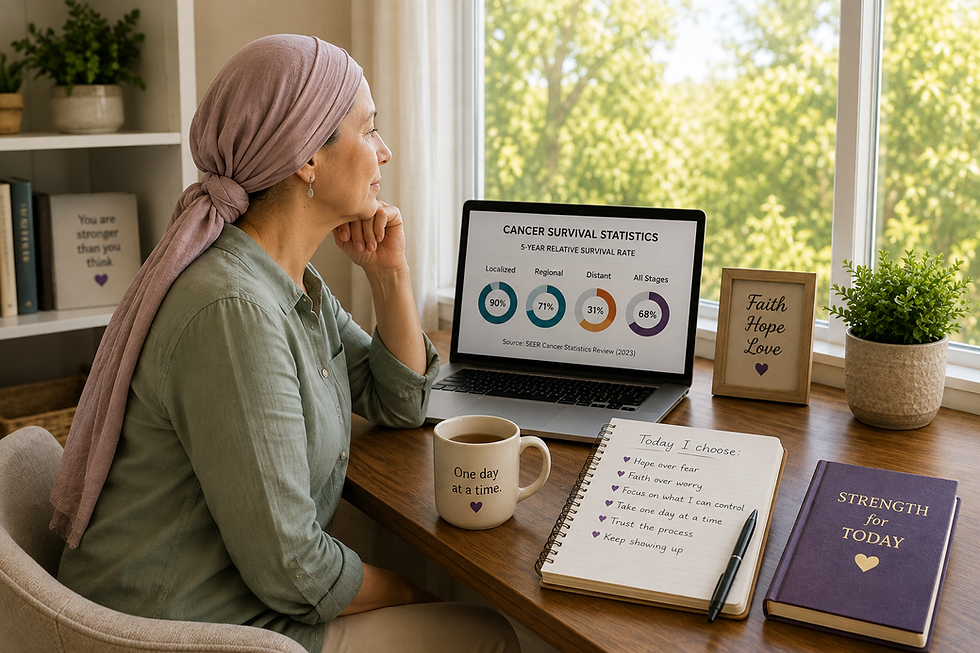
Finding hope after a cancer diagnosis can feel almost impossible when the first thing you do is search the internet for survival statistics. I wasn't looking for a reason to be afraid. I was looking for hope. Instead, I found numbers that left me crying. A frightening cancer diagnosis does not erase hope.
My doctor had warned me not to assume that I would be on the worst side of the cancer statistics. She told me that there are two sides to a statistic and to always assume you're on the good side. There are medical advances being made in cancer research.
That was good advice.
It was also extremely difficult advice to follow.
When I went home and began searching for information about uterine leiomyosarcoma, almost everything I found felt discouraging. The cancer was described as rare, aggressive, difficult to treat, and likely to return or spread.
Then I saw the survival numbers.
Depending on the page and the group of patients being discussed, I found figures ranging from approximately 13 to 17 percent for advanced disease. However, mine was morcellated and uncontained. So my survival rate is less.
I wanted to cry.
In fact, there were times when I did cry.
The Better Side of the Statistics Felt Very Small
It is easy to tell someone not to focus on a frightening statistic.
It is much harder to be the person sitting at home reading it.
When fewer people survive than die, your mind does not automatically picture yourself among the smaller surviving group. It notices how many people did not make it.
My cancer did not appear to resemble the stories with the most hopeful outcomes.
I did not have one small tumor that had been found early and removed.
I had three large masses inside my abdomen.
I had another tumor on my back.
The cancer had already appeared outside the place where it had begun.
When I looked at the people on the better side of the survival numbers, I wondered whether their situations were anything like mine.
I was trying to follow my doctor’s advice.
But I was scared.
I Had Already Made My Decision During the Drive Home
Before the biopsy gave my cancer a name, I had spent approximately six hours driving home from Virginia to West Virginia.
During that drive, I talked with God.
My mother had recently died, and she had not even been buried yet because COVID restrictions prevented everyone from gathering normally.
Before her death, I had told her that we do not choose when we are born or when we die. We choose how we face the time we are given.
Now I had to live the advice I had given her.
During that drive, I decided that I would fight.
I would keep fighting until God told me it was time to stop, or until something inside me told me that I had fought enough.
That moment has not come.
But making that promise did not mean I became fearless.
It did not make the survival statistics easier to read.
Faith gave me a direction.
It did not remove the pain of the journey.
Hope and Discouragement Can Exist Together
People sometimes speak as though hope and fear cannot live in the same person.
They can.
I believed God was with me.
I also wondered whether I would die.
I had decided to fight.
I also felt discouraged by the medical information.
I wanted to believe I could survive.
I also understood that more people with advanced uterine leiomyosarcoma died than lived five years.
None of those feelings canceled the others.
Faith does not mean pretending that a frightening diagnosis is not frightening.
Courage does not mean reading a terrible statistic without reacting.
Fighting cancer does not require you to remain cheerful every day.
Sometimes fighting means crying over the statistics and getting up the next morning anyway.
Current Survival Statistics Still Need Explanation
Survival estimates vary because different sources may use different years, stages, definitions, and patient populations.
The American Cancer Society currently reports five-year relative survival estimates for uterine leiomyosarcoma of approximately:
61 percent for localized disease
28 percent for regional disease
13 percent for distant disease
38 percent for all stages combined
These numbers are based on women diagnosed from 2015 through 2021. They describe groups rather than individual outcomes and may not fully represent more recently introduced treatments.
When I was searching in 2020, some of the information available to me was based on older data or used different categories. That helps explain why I found numbers ranging from approximately 17 to 24 percent.
But understanding why the numbers differed did not make them any easier to accept emotionally.
Then I Found the Word “Morcellated”
As I continued researching, I learned another piece of information that changed how I viewed my earlier hysterectomy.
My uterus and what had been believed to be a fibroid had been "morcellated".
I did not know what that word meant when I first heard it.
I had to search for it.
Morcellation means dividing tissue into smaller pieces so that it can be removed through a small surgical opening. A power morcellator is a device used during some laparoscopic procedures to cut tissue into fragments.
That explanation immediately frightened me.
The mass believed to be a benign fibroid had not necessarily been removed from my body as one intact piece.
It had been cut into smaller pieces inside the surgical area.
The FDA Had Warned About This Risk Years Earlier
As I researched further, I discovered that the FDA had issued a warning about laparoscopic power morcellation in 2014.
That was approximately six years before my cancer diagnosis in 2020.
The FDA warned that when a woman has an unsuspected uterine sarcoma, power morcellation can spread cancerous tissue within the abdomen and pelvis and may reduce the likelihood of long-term survival. Later FDA actions added stronger labeling and restrictions. In 2020, the agency recommended that power morcellation be used only with an approved containment system and only in appropriately selected patients.
I was angry.
I wondered why my uterus had been morcellated when federal warnings had already existed for years.
I wondered whether my doctor knew about the warnings.
I wondered whether she believed the risk did not apply to me.
I wondered whether it was simply the surgical method she had used for years.
I wondered why no one had clearly told me that an apparently benign fibroid could contain a rare cancer that might be spread if the tissue was cut apart.
Those questions stayed with me.
What I Can and Cannot Say About My Cancer
I believe morcellation contributed to the spread of my cancer.
The cancer later appeared in my abdomen and in the mass on my back. Learning that the original uterine tissue had been morcellated gave me a possible explanation for how cancer cells could have been dispersed.
However, I also want to be medically responsible.
Unless my doctors documented that morcellation definitively caused each later tumor, I cannot present that conclusion as proven fact.
Uterine leiomyosarcoma can spread through the bloodstream and can metastasize even when a tumor is removed intact.
What medical evidence does establish is that morcellating an unsuspected uterine malignancy can disseminate cancerous tissue and may worsen prognosis. ACOG states that leiomyosarcoma cannot be reliably identified before surgery and that morcellation of an occult malignancy may spread the cancer and potentially worsen the patient’s outcome.
That risk alone is serious enough for every patient to understand.
This Is Not a Warning Against Every Laparoscopic Surgery
At first, I wanted to tell everyone:
“Never let them do laparoscopic surgery on a fibroid.”
After learning more, I realized that statement would be too broad.
Laparoscopy describes surgery performed through small incisions using a camera and specialized instruments. Many laparoscopic procedures do not involve morcellating a uterine tumor. Laparoscopic surgery can offer benefits such as smaller incisions, shorter hospital stays, and faster recovery than open abdominal surgery.
The critical questions are:
Will the uterus or fibroid be removed intact?
Will it be cut into pieces?
Will a power morcellator be used?
Will the tissue be contained inside an approved bag?
Could the mass be removed through the vagina or a slightly larger incision without cutting it apart?
Have factors that increase concern for cancer been evaluated?
Has the patient been told that leiomyosarcoma cannot be completely ruled out before surgery?
The surgical route and the method used to remove the tissue are related, but they are not identical.
Current FDA Guidance Does Not Say “Morcellate Everyone in a Bag”
Current FDA guidance says power morcellation should be performed only with a legally marketed containment system when morcellation is appropriate.
It also advises against laparoscopic power morcellation when:
Cancer is known or suspected
The patient is postmenopausal
The patient is older than 50
The uterus or fibroid can be removed intact through the vagina
The tissue can be removed through a small abdominal incision without morcellation
The FDA explains that the risk of unsuspected cancer increases with age, particularly in women older than 50.
A containment system may reduce the spread of morcellated tissue, but it does not make the procedure completely risk-free. The FDA has stated that containment systems cannot prevent all possible cancer spread, including spread that may have occurred before surgery or cancer cells transported through blood or lymphatic vessels.
Most Fibroids Are Not Cancer
I do not want women with fibroids to believe that every fibroid is secretly uterine leiomyosarcoma.
Fibroids are common benign growths.
They almost never become cancer, and having fibroids does not itself mean a woman has an increased risk of uterine cancer.
The problem is not that most fibroids are dangerous.
The problem is that a rare uterine leiomyosarcoma can sometimes resemble a fibroid before surgery, and there is no dependable test that rules it out in every patient.
That uncertainty should be part of the conversation before tissue is cut into pieces.
What I Want Patients to Ask
Before agreeing to surgery for a fibroid, ask:
How certain are you that this is a benign fibroid?
Is there anything about my age, symptoms, imaging, or medical history that increases concern for cancer?
Can uterine leiomyosarcoma be reliably ruled out before surgery?
Will you remove the mass or uterus intact?
Are you planning to morcellate the tissue?
Will the morcellation be manual or powered?
Will it occur inside a containment system?
What are the risks if the mass contains an unsuspected cancer?
What alternatives would allow the tissue to be removed whole?
Would a gynecologic oncologist or another specialist review be appropriate?
What information will be included in my consent form?
Can I have time to obtain a second opinion?
A patient should not first learn the word "morcellation" after receiving a metastatic cancer diagnosis.
What I Wish I Had Known
I wish I had known that my tissue might be cut into smaller pieces inside my body.
I wish someone had explained that a uterine mass could rarely be leiomyosarcoma even when it appeared to be a fibroid.
I wish someone had discussed the FDA warnings with me.
I wish I had known enough to ask whether my uterus could be removed intact.
I wish I had been offered the opportunity to compare the easier recovery of minimally invasive surgery with the rare but devastating risk of spreading an undiagnosed cancer.
I cannot go back and ask those questions before my surgery.
I can help another woman ask them before hers.
My Anger Became Advocacy
Reading about morcellation made me angry.
At first, that anger had nowhere to go.
I could not put the pieces of my uterus back together.
I could not return to the day of my hysterectomy and choose another method.
I could not know with certainty how my life would have unfolded if the mass had been removed intact.
What I could do was learn.
I could tell my story.
I could encourage women to ask questions that I did not know to ask.
I could remind doctors that rare does not mean nonexistent.
I could make sure another patient understood that “minimally invasive” describes the size of the incisions. It does not automatically mean that every part of the proposed surgery carries the lowest possible cancer risk.
Hope for Today
The information I found during those first searches was not hopeful.
The statistics were frightening.
Learning about morcellation added anger to my fear.
I was trying to understand whether a surgery that was supposed to help me had unknowingly contributed to spreading cancer throughout my body.
Still, I held on to the decision I made during that six-hour drive.
I would keep fighting.
I would stop only when God told me it was time or when I knew inside myself that I had fought enough.
That time has not come.
I reached my five-year milestone.
I became one of the people represented on the better side of those frightening numbers.
Today, fighting means more than continuing my own treatment.
It also means warning other women to ask how their uterine tissue will be removed.
Do not panic because you have a fibroid.
Do not assume that every laparoscopic procedure is dangerous.
But do not agree to having a uterine mass cut into pieces until you understand why it is being proposed, what the FDA says, what alternatives exist, and what could happen if that presumed fibroid is one of the rare cancers that cannot be recognized in advance.
You deserve that conversation before surgery.
Find Your Community
No one should have to face life's challenges alone. At Surviving Life Lessons, we believe in life survivors helping life strugglers. Explore our growing Community Groups to connect with others who understand your journey, share encouragement, and find hope through meaningful conversations. You'll also have the opportunity to introduce yourself and share your own story of overcoming. Your story matters. It may be the encouragement someone else needs to keep moving forward, reminding them that they are not alone and that hope is always possible.
Your Story Matters
We need your nice comments below! Your thoughts, experiences, and lessons learned might be exactly what someone else needs to hear today.
Drop a comment, Say Hello, and join the conversation.
Need More Personalized Support?
Everyone's journey is unique. If you're looking for personalized guidance, encouragement, or one-on-one support, explore our services to find the option that's right for you. We're here to help you take your next step with confidence and hope.
Helpful Resources for Your Journey
Explore our collection of books, journals, coloring books, and printable PDFs designed to encourage, inspire, and support you every step of the way.
References
American Cancer Society: "Survival Rates for Uterine Sarcoma", https://www.cancer.org/cancer/types/uterine-sarcoma/detection-diagnosis-staging/survival-rates.html
U.S. Food and Drug Administration - UPDATE: "Perform Only Contained Morcellation When Laparoscopic Power Morcellation Is Appropriate: FDA Safety Communication", https://www.fda.gov/medical-devices/safety-communications/update-perform-only-contained-morcellation-when-laparoscopic-power-morcellation-appropriate-fda
U.S. Food and Drug Administration: "Laparoscopic Power Morcellators", https://www.fda.gov/medical-devices/surgery-devices/laparoscopic-power-morcellators
American College of Obstetricians and Gynecologists: "Uterine Morcellation for Presumed Leiomyomas", https://www.acog.org/clinical/clinical-guidance/committee-opinion/articles/2021/03/uterine-morcellation-for-presumed-leiomyomas
Mayo Clinic - Uterine Fibroids: "Symptoms and Causes", https://www.mayoclinic.org/diseases-conditions/uterine-fibroids/symptoms-causes/syc-20354288
About the Author:
Deborah Ann Martin is the founder of Surviving Life Lessons, a published author, poet, speaker, and trainer with over 20 years of management experience across multiple industries. An MBA graduate, U.S. veteran, single mother, and rare cancer survivor, Deborah brings both professional expertise and lived experience to her writing on resilience, leadership, personal growth, and overcoming adversity. Her mission is to empower others with practical wisdom and real-life insight to navigate life’s challenges with strength and purpose.


.png)
Comments