

SMART Goals for Better Boundaries

Updated: Sep 29
Healthy boundaries are one of the most important parts of emotional well-being. They protect your peace, your time, your relationships, and your ability to function without resentment or burnout. But many people struggle with boundaries because they fear disappointing others, being misunderstood, or appearing selfish.
SMART goals help you build better boundaries one small, realistic step at a time so change feels safe, doable, and empowering.
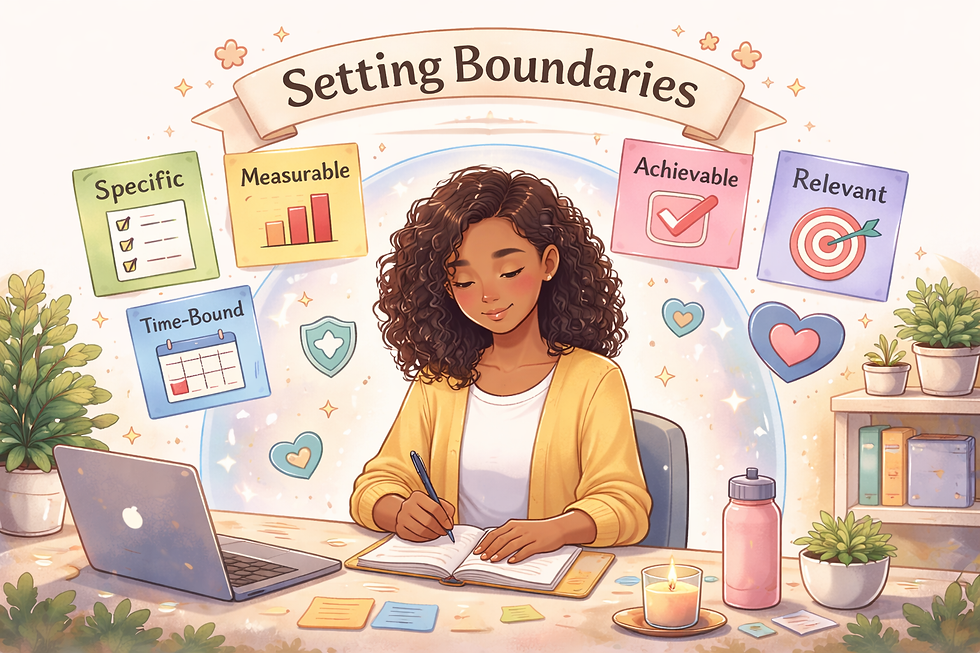
Why Boundaries Need SMART Goals
Boundary challenges usually come from:
• guilt about saying no
• being overwhelmed with responsibilities
• unclear expectations
• people-pleasing patterns
• fear of conflict
• lack of practice communicating needs
SMART goals make boundaries easier by breaking them into compassionate, realistic actions that protect your emotional and mental health.
Healthy boundaries are not rejection. They are self-respect.
Phase One: Identifying Your Boundaries
You cannot set a boundary unless you know what you need.
Step 1: Notice your discomfort
SMART goal example: “I will write down one moment today when I felt overwhelmed or uncomfortable.”
Why it matters: Discomfort is your body signaling a need.
Step 2: Identify the cause
SMART goal example: “I will list one reason I felt that discomfort.”
Why it matters: Naming the problem reduces emotional pressure.
Step 3: Define what you need
SMART goal example: “I will write one sentence describing what would have made me feel better.”
Why it matters: Needs are valid. Naming them gives direction.
Step 4: Choose one small boundary to set
SMART goal example: “I will select one boundary to practice this week.”
Why it matters: Small consistent changes build confidence.
Awareness is the foundation of healthy boundaries.
Phase Two: Practicing Saying No
Saying no is a skill, not a personality trait.
Step 1: Start small
SMART goal example: “I will say no to one low-priority request this week.”
Step 2: Use simple language
SMART goal example: “I will practice responding with one clear sentence, such as, ‘I can’t do that today.’”
Step 3: Pause before agreeing
SMART goal example: “I will wait five seconds before saying yes.”
Step 4: Reduce guilt
SMART goal example: “I will remind myself once a day that saying no protects my well-being.”
Every small “no” builds confidence and emotional safety.
Phase Three: Setting Boundaries With Your Time
Time boundaries protect your energy and prevent burnout.
Step 1: Limit availability
SMART goal example: “I will set aside ten minutes each evening without interruptions.”
Step 2: Block your schedule
SMART goal example: “I will schedule one focused work block each day.”
Step 3: Protect personal time
SMART goal example: “I will keep one hour each week for myself.”
Step 4: End conversations or tasks intentionally
SMART goal example: “I will use one simple phrase such as, ‘I need to go now,’ once this week.”
Small time boundaries create big life changes.
Phase Four: Protecting Emotional Boundaries
Emotional boundaries help you avoid absorbing stress, guilt, or conflict from others.
Step 1: Recognize emotional limits
SMART goal example: “I will write one sentence describing an emotion that drained me today.”
Step 2: Limit emotional labor
SMART goal example: “I will step away from one conversation when I feel overwhelmed.”
Step 3: Respond with calm clarity
SMART goal example: “I will use one sentence to express how I feel without overexplaining.”
Step 4: Release responsibility
SMART goal example: “I will remind myself once a day that other adults are responsible for their own feelings.”
Emotional boundaries protect your peace, your heart, and your energy.
Phase Five: Communicating Boundaries Clearly
Boundaries only work when communicated clearly and respectfully.
Step 1: Use short statements
SMART goal example: “I will practice expressing one need in a single sentence.”
Step 2: Avoid overexplaining
SMART goal example: “I will keep my boundary to fifteen words or fewer.”
Step 3: Repeat when necessary
SMART goal example: “I will calmly restate a boundary one time if it’s ignored.”
Step 4: Back up words with action
SMART goal example: “I will follow through on one boundary this week.”
Clear communication builds mutual respect.
Phase Six: Maintaining Boundaries Without Guilt
Boundaries require consistency, not perfection.
Step 1: Allow imperfection
SMART goal example: “I will give myself grace for one boundary slip.”
Step 2: Review success
SMART goal example: “I will spend two minutes each week reflecting on how boundaries helped me.”
Step 3: Strengthen one boundary at a time
SMART goal example: “I will focus on only one new boundary each week.”
Step 4: Celebrate growth
SMART goal example: “I will acknowledge one moment I protected my peace.”
Healthy boundaries create healthier relationships, including the one with yourself.
When Setting Better Boundaries Feels Too Hard
There will be moments where boundaries feel scary. Not because you are weak, but because you have likely spent years prioritizing others over yourself.
When boundaries feel difficult:
• pause before responding
• choose the smallest boundary possible
• remind yourself you deserve peace
• remember that kind people have boundaries too
• know that anyone who benefits from your lack of boundaries may resist them
Boundaries are not selfish. They are survival.
Boundaries Are a Form of Self-Respect
You do not need to become a different person to have better boundaries. You simply need realistic, compassionate steps that protect your time, energy, and emotional well-being.
SMART goals help you build boundaries in a way that feels safe, clear, and sustainable.
Journal Prompt: Boundaries Reflection
• Where in my life do I feel most drained?
• Who or what regularly crosses my boundaries?
• What am I afraid will happen if I say no?
• Where do I most need protection right now?
• What boundary do I wish I could set without guilt?
• What is one boundary I am willing to practice this week?
Where to Go From Here
Setting goals for better boundaries is easier when you have people cheering you on. At Surviving Life Lessons, we believe in life survivors helping life strugglers. Our Boundary Setting Support Group can help you protect your peace, and our Motivation & Mindset group can help you keep moving forward. You can also browse our Community Groups Catalog to find every group that fits where you are right now.
To keep going, read SMART Goals for Creating Better Daily Routines or SMART Goals for Better Time Management.
Your Story Matters
We need your nice comments below! Your thoughts, experiences, and lessons learned might be exactly what someone else needs to hear today.
Drop a comment, Say Hello, and join the conversation.
Need More Personalized Support?
Everyone's journey is unique. If you're looking for personalized guidance, encouragement, or one-on-one support, explore our services to find the option that's right for you. We're here to help you take your next step with confidence and hope.
Helpful Resources for Your Journey
Explore our collection of books, journals, coloring books, and printable PDFs designed to encourage, inspire, and support you every step of the way.
Want help turning your goals into real steps? Book Next Step Coaching
About the Author:
Deborah Ann Martin is the founder of Surviving Life Lessons, a published author, poet, speaker, and trainer with over 20 years of management experience across multiple industries. An MBA graduate, U.S. veteran, single mother, and rare cancer survivor, Deborah brings both professional expertise and lived experience to her writing on resilience, leadership, personal growth, and overcoming adversity. Her mission is to empower others with practical wisdom and real-life insight to navigate life’s challenges with strength and purpose.




.png)
Comments