

Fibroids and Morcellation: What I Wish I Had Known Before Surgery

Updated: Sep 28
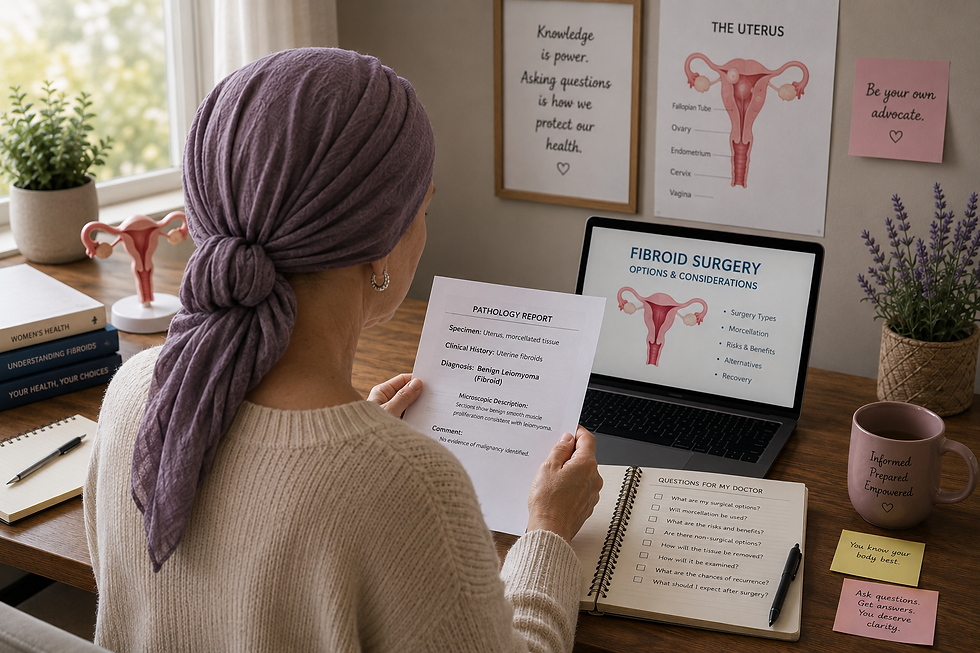
My Uterine Leiomyosarcoma Misdiagnosis: Lessons Learned about Fibroids and Morcellation, Patient Advocacy, and a Message for the Next Woman
If you have been told that you have uterine fibroids and are considering surgery, I want you to know something I wish someone had told me before my hysterectomy: Fibroids and morcellation were words I did not understand before surgery.
Most fibroids are benign but the word “fibroid” does not always tell the whole story.
Uterine leiomyosarcoma is rare, and current medicine cannot reliably identify every leiomyosarcoma before surgery. A tumor that is ultimately diagnosed as leiomyosarcoma can sometimes resemble a benign fibroid.
I am not telling you that your fibroid is cancer.
I am telling you what happened to me because I believe women deserve to understand the questions surrounding fibroid surgery before they make decisions about their bodies.
In 2018, I underwent a hysterectomy for what was believed to be a fibroid uterus. My tissue was removed through morcellation. The original pathology was reported as benign.
I believed the problem had been solved.
Nearly two years later, in 2020, I learned that I had metastatic uterine leiomyosarcoma.
By then, the cancer had spread through my pelvis and beyond, as a bump on my back.
My experience changed the way I think about fibroid surgery, morcellation, pathology, informed consent, and patient advocacy.
I cannot change what happened to me.
But I can share what I learned.
I can encourage women to ask how their tissue will be removed, whether morcellation is planned, what alternatives exist, and how the tissue will be examined.
I can encourage patients to understand that a rare cancer cannot always be ruled out before surgery.
And I can ask doctors and pathologists to keep learning from difficult cases.
This is not a story meant to frighten women with fibroids. It is a story meant to help them ask better questions.
If my experience causes one woman to have a conversation with her doctor that I did not know to have, then sharing it is worthwhile.
The Original Answer Was Wrong
The hardest part was knowing that the tissue removed in 2018 had been called benign.
The laboratory did not identify uterine leiomyosarcoma at that time.
The uterus had also been morcellated, meaning the tissue had been divided before removal.
Once the later diagnosis was made, my earlier pathology had to be reconsidered in light of what was now known.
I went from believing I had undergone routine treatment for fibroids to understanding that I had a rare metastatic cancer.
I did not get to return to the life I had before.
I Needed the Gynecologist to Know
After I had time to understand the diagnosis, the surgery, the morcellation, and the long-term consequences, I decided to contact my original gynecologist.
I used MyChart because I wanted my words documented clearly.
I explained that the way the surgery was performed and the laboratory’s failure to identify the cancer had caused me to face a lifelong fight.
I gave him the name of my oncologist.
I wanted him to have access to someone who understood the rare cancer I had developed.
Most importantly, I asked him to treat my case as a lesson learned.
I did not want another woman to go through what I had experienced.
I Was Not Writing Only for Myself
My message was about my life, but it was also about the next patient.
Another woman could walk into the same office with what appeared to be a fibroid.
She could trust the same type of imaging.
She could undergo a similar surgery.
Her tissue could be removed in pieces.
The pathology could fail to identify a rare cancer, particularly when the tumor is difficult to distinguish from a benign smooth-muscle tumor.
By the time the truth became clear, the disease might no longer be limited to the uterus.
I could not undo my surgery.
I could not put the tissue back together.
I could not return to 2018 and ask different questions.
I could ask the doctor to learn from what happened.
His Nurse Responded
The gynecologist did not answer me directly.
His nurse replied through MyChart and said she would make sure he received my message.
I never heard anything further from him.
There was no apology.
There was no explanation.
There was no discussion about the surgery or pathology.
There was no message telling me whether anything would change.
For a while, I had no way of knowing whether my words mattered.
I Did Not Contact Him for an Argument
I would have appreciated a response.
I would have appreciated acknowledgment of what I was living through.
But the purpose of the message was not to force him into an argument.
I wanted the information to reach him.
I wanted him to know the name of my oncologist.
I wanted my experience to become part of his future decision-making.
Sometimes advocacy does not provide the closure we hope to receive.
The person may never answer.
That does not mean speaking was pointless.
Before Leaving West Virginia, I Learned Something Had Changed
Later, before I moved from West Virginia to Virginia, my oncologist told me that she and my original gynecologist had collaborated on several cases.
She told me that the laboratory was now looking more specifically for uterine leiomyosarcoma, particularly in women over fifty when the tissue or clinical circumstances raised concern.
She also told me that the way I had handled the gynecologist had made a difference.
According to what my oncologist told me, their increased attention helped identify another woman’s uterine leiomyosarcoma while it was still Stage I.
I was not present for that patient’s care.
I did not review her records.
I cannot independently verify every detail of her diagnosis.
I can truthfully say that my oncologist told me my message and the lessons from my case had influenced later collaboration and awareness.
I Did Not Save Her by Myself
I want to be careful with this part of the story.
I did not personally diagnose the other patient.
I did not review her pathology.
I did not perform her surgery.
Doctors, pathologists, and other medical professionals were responsible for her care.
My experience may have encouraged them to look more closely.
My message may have contributed to a change in awareness.
That matters without claiming that I alone saved another woman.
That Was the Outcome I Wanted
When I wrote the MyChart message, I asked for one thing above all:
“Please use what happened to me as a lesson so another person does not have to go through this.”
I did not know whether that request would be honored.
Learning that the gynecologist and oncologist had worked together on later cases gave me some peace.
Learning that another woman may have been identified at Stage I gave the suffering a purpose I had not expected.
It did not erase what happened to me.
It showed that a painful lesson could change what happened next.
Early Detection Can Change the Choices Available
Uterine leiomyosarcoma is rare and can be difficult to distinguish from a benign fibroid before surgery. ACOG states that leiomyosarcoma cannot currently be diagnosed reliably before an operation, even though patients should be evaluated for signs that may increase concern for malignancy.
When uterine sarcoma is known or suspected before surgery, the surgical plan can be adjusted to the cancer risk. Surgery is often both the main way uterine sarcoma is diagnosed and its primary treatment, with treatment planning influenced by the stage and extent of disease.
Finding a cancer while it remains limited to the uterus may provide different surgical and treatment options than discovering it after it has spread.
That is why early identification matters so much to me.
Too Many Women Learn the Answer Late
Fibroids and uterine leiomyosarcoma can go without symptoms for a while.
A woman may be told that a growing uterine mass is probably a fibroid.
Most fibroids are benign.
That is important to acknowledge.
I do not want every woman with fibroids to believe she has uterine leiomyosarcoma.
But rare does not mean impossible.
The problem is that a rare cancer can resemble a common benign condition.
ACOG acknowledges that there is no reliable way to rule out every leiomyosarcoma before surgery for a presumed fibroid.
That uncertainty makes careful evaluation, informed consent, tissue-handling decisions, and pathology review especially important.
Pathology Matters as Much as Surgery
My experience involved two connected problems.
The tissue was morcellated.
I cannot know from my own experience alone exactly why the original cancer was not identified. A difficult diagnosis can involve the appearance of the tumor, the specimen available for examination, the limitations of testing, or an interpretive error. My later diagnosis meant that the earlier specimen and diagnosis had to be reconsidered in light of what was subsequently discovered.
Surgery determines how the tissue leaves the body.
Pathology determines what the tissue is believed to contain.
Both matter.
A pathologist evaluates the tumor tissue microscopically and may use additional immunohistochemical or molecular studies when appropriate to help distinguish leiomyosarcoma from other uterine tumors. Difficult cases may also warrant review by a pathologist with specialized expertise in gynecologic or sarcoma pathology. A biopsy or surgical specimen is required to confirm leiomyosarcoma.
When tissue is fragmented, evaluating the full tumor’s size, borders, pattern, and relationship to surrounding tissue may become more difficult.
My Hope for Better Tumor Testing
My experience has made me a strong supporter of learning as much as possible from removed tumors.
I want unusual, rapidly growing, postmenopausal, or otherwise concerning uterine masses to receive careful pathological evaluation, with specialist review considered when the diagnosis is difficult or unusual.
I want tissue handled and preserved appropriately so that the pathologist has the best possible material available for diagnosis. I want all rare cancer tumors to be preserved with the patient's consent to give researchers materials to adequately study.
I want difficult cases reviewed by pathologists with experience in gynecologic or sarcoma tumors.
I want appropriate additional pathological, immunohistochemical, molecular, or tumor testing to be considered when it may help clarify a difficult diagnosis or guide treatment.
I want the medical community to keep building knowledge from every rare tumor it encounters. I want every unusual tumor to teach us as much as medically appropriate, through careful pathology, appropriate testing, research, and shared medical knowledge.
My later tumor profiling found that my cancer was estrogen-receptor positive, progesterone-receptor positive, microsatellite stable, and carried an ALK fusion.
That information became important to my treatment decisions.
Genetic Testing and Tumor Testing Are Not the Same
The word **genetic testing** can mean different things.
Germline genetic testing looks for inherited changes a person may have been born with and could potentially pass through a family.
Tumor testing examines changes found inside the cancer cells.
My family or germline testing did not identify an inherited cancer finding.
My tumor testing did identify features that helped my doctors and me consider treatment choices.
When I say I want more testing of tumors, I am mainly talking about careful pathology and appropriate molecular analysis of the tissue itself.
I am not saying that every common fibroid currently requires every available molecular test.
I am saying we should keep studying these tumors so knowledge grows and rare cancers become easier to identify.
We Need a Larger Body of Knowledge
Rare cancers remain difficult partly because each doctor or laboratory may see very few cases.
One gynecologist may treat hundreds of fibroids and never knowingly encounter uterine leiomyosarcoma.
A general pathologist may see only a small number of uterine sarcomas.
That makes shared knowledge important.
Cases can teach:
Which symptoms raised concern
Which imaging features mattered
Which pathology findings were subtle
Which patients needed expert review
Which tumor changes appeared repeatedly
Which treatments worked
Which surgeries created added risk
Which patients were found earlier
No single case can answer every question.
Thousands of carefully documented cases can move medicine forward.
Age Should Not Be the Only Factor
My oncologist told me the laboratory had become more alert to possible uterine leiomyosarcoma, especially in women fifty and older.
Age matters because the risk of an unsuspected uterine sarcoma increases as women get older. The FDA states that the risk of an unsuspected uterine sarcoma increases with age and specifically recommends against power morcellation for presumed fibroids in postmenopausal women or women over 50. Age is one factor in evaluating risk, but it should not be treated as the only factor.
But age should not become the only deciding factor.
A younger woman can still develop uterine leiomyosarcoma.
A doctor should consider the whole picture:
Age
Menopausal status
Growth pattern
Symptoms
Imaging
Medical history
Previous procedures
Tumor appearance
Clinical concern
A checklist should help doctors think.
It should not replace thinking.
One Early Diagnosis Matters
Hearing that another woman may have been diagnosed at Stage I affected me deeply.
I had entered the cancer system after the disease had already spread.
She may have entered it while the cancer was still limited.
I do not know what happened after her diagnosis.
I hope she received the care she needed.
I hope she had more options.
I hope she never had to endure the type of journey I faced.
One person found earlier does not repair my body.
It does show why speaking up matters.
Early Detection Is the Goal
I want a future in which uterine leiomyosarcoma can be identified earlier and more reliably, rather than too often becoming apparent only after the disease has progressed.
I want research that helps doctors distinguish suspicious tumors from ordinary fibroids.
I want improved imaging.
I want better biomarkers.
I want stronger pathology tools.
I want tumor registries and tissue research.
I want women to understand surgical options.
I want doctors to know when expert consultation is needed.
I want rare tumors found while treatment choices are still wider.
If You Are Told You Have a Fibroid
If you are told you have a fibroid, know that most fibroids are benign. But current medicine cannot reliably rule out every uterine sarcoma before surgery.
That does not mean you should assume you have cancer.
It means you should understand what your doctors know, what remains uncertain, and how that uncertainty affects your surgical choices.
Before surgery, ask:
How was the diagnosis evaluated?
How will the tissue be removed?
Will morcellation be used?
What alternatives to morcellation are available?
Can the uterus or mass be removed intact?
How will the tissue be examined by pathology?
What happens if the pathology is unusual or does not clearly show a benign fibroid?
You have the right to understand the diagnosis, the surgical approach, the alternatives, and the plan for examining the tissue before you consent to surgery.
My experience taught me that being told “fibroid” does not mean you should be afraid—but it does mean you should be informed.
Questions to Ask Before Fibroid Surgery
If you have been told that you have a fibroid and surgery has been recommended, you do not need to assume that you have cancer. Most fibroids are benign.
But it is reasonable to understand what is known, what is uncertain, and how the surgical plan accounts for the possibility of an unexpected diagnosis.
Consider asking:
How confident are we that this is a fibroid?
Are there any features of my age, menopausal status, symptoms, growth pattern, imaging, or medical history that make you more concerned about another type of uterine tumor?
How will the mass and/or uterus be removed?
Will the tissue be removed intact or fragmented?
Will power morcellation be used?
If power morcellation is being considered, will a legally marketed tissue-containment system be used?
What alternatives to morcellation are available for me?
Could the uterus or mass be removed intact through another surgical approach?
What happens if the pathology is not clearly benign?
Who will examine the specimen?
If the diagnosis is unusual or uncertain, would review by a gynecologic pathologist or sarcoma specialist be appropriate?
When will I receive the final pathology results?
If the pathology identifies cancer, what would happen next?
Would consultation with a gynecologic oncologist before surgery be appropriate in my particular situation?
These questions do not mean that you believe you have cancer.
They mean that you want to understand the diagnosis, the uncertainty, the surgical options, and the risks before making an informed decision.
Uterine leiomyosarcoma is rare, and current medicine cannot reliably distinguish every leiomyosarcoma from a benign fibroid before surgery. That uncertainty is one reason the method of tissue removal and the pathology plan deserve careful discussion.
For current information about morcellation and the FDA's recommendations, patients should consult the FDA's current patient guidance rather than relying only on older articles or personal accounts.
Before Surgery, Ask How the Tissue Will Be Removed
Before agreeing to a procedure involving morcellation, a patient should understand:
Why morcellation is being considered
Whether power morcellation will be used
Whether a legally marketed tissue-containment system will be used when power morcellation is considered appropriate
What alternatives exist
Whether the uterus or mass can be removed intact
Whether age, menopausal status, symptoms, imaging, growth pattern, or other circumstances affect the concern for an unsuspected uterine sarcoma
What could happen if an unsuspected cancer is present
How the specimen will be evaluated by pathology
Whether additional pathology review might be appropriate if the diagnosis is unusual or uncertain
The FDA recommends that laparoscopic power morcellation be limited to appropriately selected patients and, when it is considered appropriate, performed with a legally marketed tissue-containment system. The FDA also recommends against power morcellation for presumed fibroids in postmenopausal women or women over 50.
A patient should understand how the tissue will be removed before consenting to surgery.
A Smaller Scar Is Not Always the Most Important Goal
Many patients prefer minimally invasive surgery.
I understand why.
Smaller incisions may mean less immediate pain, shorter hospital stays, and faster recovery.
Those benefits matter.
But the smallest scar is not always the safest outcome.
Had I understood the possibility that my mass could be cancer, I would have accepted a larger incision to have the uterus removed intact.
A larger scar would have been easier to live with than metastatic cancer.
I Wanted Education, Not Revenge
I had a 17% chance at the time to survive 5 years. I didn't want to spend all that time wasted in court battles. I wanted to spend my time with my friends and family, seeing more and doing more, and fighting to make my 5 years.
I was angry. But I was not going to let my heart turn hard and bitter. I wasn't going to wish the worst on this doctor. I know he was a good doctor. That was why he did my hysterectomy. I don't know why he made the mistake. I don't know why he didn't have the CDC information on morcellation. There are so many unknowns. I wasn't going to waste my precious time harboring ugly feelings. So I forgave him.
I was angry that the original pathology did not identify my leiomyosarcoma. I still do not know exactly why the cancer was not recognized in the original specimen. Whether the explanation was the difficulty of distinguishing the tumor, the fragmented specimen, someone careless, the assumption that it was a fibroid, an interpretive error, or something else, the consequence for me was the same: the cancer was not identified when the tissue was first examined. There are so many unknowns. I wasn't going to waste my precious time harboring ugly feelings. So I forgave them.
I was angry.
I was grieving.
I was facing chemotherapy, surgeries, long-term treatment, financial costs, chronic illness, and the possibility that cancer would return.
It would have been understandable to want punishment.
What I wanted most was prevention.
What I really want is all fibroids tested for uterine leiomyosarcoma.
I wanted the gynecologist to remember me the next time a patient’s situation did not fit neatly into the word **fibroid**.
I wanted the pathologist to look twice.
I wanted the surgical team to ask whether the tissue should be removed intact.
I wanted the next woman to receive information I had not received.
Lessons Learned Should Be Part of Medicine
In business, technology, the military, and project management, teams often conduct a lessons-learned review after something goes wrong.
They ask:
What happened?
What was expected to happen?
Where did the process fail?
What warning signs were missed?
What should be done differently next time?
How will the lesson be shared?
Medicine needs that same mindset.
A bad outcome should not be hidden inside one patient’s chart.
The lesson should become part of better care.
Patients Can Contribute to Lessons Learned
Patients see parts of the process that individual doctors may not.
We know:
What we were told
What we were not told
Which symptoms were dismissed
How long the diagnosis took
How the surgery was explained
Whether alternatives were discussed
How the illness affected our lives afterward
Which parts of the system failed to connect
A patient’s account is not a replacement for medical records.
It adds context the records may not show.
My MyChart message explained what the decisions had meant after I left the operating room.
You May Never Receive an Answer
Patients who contact a former doctor should prepare for the possibility that the doctor will not respond.
There may be legal concerns.
The doctor may feel defensive.
The office may send the message to risk management.
The clinician may read it privately and never reply.
The lack of an answer can feel like another dismissal.
Still, the message may be read.
It may influence a later conversation.
It may change a future decision.
I never received a direct response from my gynecologist.
According to my oncologist, something changed anyway.
How to Write a Lessons-Learned Message
A useful message may include:
The approximate date of the original procedure
What the patient was told
What was later discovered
The current diagnosis
The name of the treating specialist
The medical and personal consequences
The specific concern
What the patient hopes will change
A request that the case be reviewed
A request that future patients receive better information
The message can be direct without being threatening.
The goal determines the tone.
My goal was to make the doctor understand that the outcome had not ended when I left his care.
A Patient Can Be Angry and Constructive
Being constructive does not mean pretending everything was acceptable.
I told the gynecologist that the surgery and misdiagnosis had caused me to fight for the rest of my life.
That was not gentle language.
It was accurate.
I also provided my oncologist’s information and asked for the experience to become a lesson.
Anger and purpose can exist together.
What I Wish Someone Had Told Me
I wish I had known that a pathology report can sometimes fail to identify a rare cancer, particularly when a tumor resembles a benign fibroid.
I wish I had known that uterine leiomyosarcoma could resemble a fibroid.
I wish someone had explained exactly how my uterus and the presumed fibroid tissue would be removed, including whether the tissue would be removed intact or fragmented and what risks that could create if an unsuspected cancer were present.
I wish I had understood the risks of morcellating an unsuspected cancer.
I wish I had known that a rare diagnosis might require expert pathology review.
I wish someone had told me I could contact the original doctor later and ask him to learn from my outcome.
Most of all, I wish someone had said:
“You may never receive the apology or answer you deserve, but your story may still change what happens to the next patient.”
Hope for Today
I contacted my original gynecologist through MyChart.
I told him that the surgery and the missed diagnosis had left me fighting for my life.
I gave him the name of my oncologist.
I asked him to use my case as a lesson so another woman would not have to go through the same thing.
His nurse said she would deliver the message.
He never responded.
Later, my oncologist told me that she and the gynecologist had collaborated on other cases.
She said the laboratory was looking more carefully for uterine leiomyosarcoma, especially in women over fifty when the circumstances raised concern.
She told me another woman had been identified at Stage I.
She believed the way I handled the situation made a difference.
I cannot change what happened to me.
I can continue speaking so another woman asks more questions.
I can encourage doctors to look again.
I can support research that helps pathologists recognize rare tumors.
I can ask that removed tissue teach us everything it can.
I can advocate for appropriate tumor testing while acknowledging that current medicine still cannot reliably identify every uterine leiomyosarcoma before surgery.
Earlier diagnosis can provide patients and doctors with more information and, depending on the disease and stage, may provide different treatment options.
That is why early identification matters so much to me. I don't want any woman to go through what I am going through. I don't want any more families to be without their daughter, mother, or wife.
Even when medicine does not yet have the perfect test, every carefully reviewed case moves us closer to one.
Frequently Asked Questions
How did I contact the gynecologist?
I sent a message through MyChart after learning that my earlier uterine tumor had been uterine leiomyosarcoma.
Did he respond?
His nurse replied that she would give him the message. I did not receive a direct response from him.
What did I tell him?
I explained that the surgical method and original pathology misdiagnosis had left me fighting cancer for the rest of my life. I gave him my oncologist’s name and asked him to use my case as a lesson.
Did my message lead to another patient’s Stage I diagnosis?
My oncologist later told me that she and the gynecologist had collaborated on several cases and that another patient had been identified at Stage I. She believed my approach made a difference. I cannot independently verify the other patient’s records or claim sole credit.
Can uterine leiomyosarcoma be reliably ruled out before fibroid surgery?
No. Current medical guidance states that leiomyosarcoma cannot be reliably diagnosed before surgery in every case.
Why is morcellation a concern?
If an unsuspected uterine sarcoma is present, morcellation can spread cancerous tissue within the abdomen and pelvis.
Does every fibroid need molecular testing?
That is not currently the standard recommendation. My advocacy is for careful evaluation, informed tissue handling, expert pathology when needed, preservation of useful tissue, and appropriate tumor testing when findings are suspicious or cancer is identified.
What is the difference between germline and tumor testing?
Germline testing looks for inherited changes present throughout the body. Tumor testing examines changes found in the tumor cells. My germline testing did not identify an inherited finding, while my tumor testing identified features that affected treatment discussions.
Why does early diagnosis matter?
Earlier diagnosis may allow cancer to be treated while it is still limited and before it spreads to distant locations. Treatment options and outcomes vary by patient and disease stage.
Where to Go From Here
Finding out about morcellation after surgery can bring up anger, fear, and questions about your care. At Surviving Life Lessons, we believe in life survivors helping life strugglers. Our Healthcare Self-Advocacy Support Group is a place to learn what to ask before surgery, and our Cancer Support Group connects you with others who have faced a surprise diagnosis. You can also browse our Community Groups Catalog to find every group that fits where you are right now.
Next, read What Is Uterine Morcellation? What I Wish I Had Known Before My Hysterectomy or Can a Fibroid Actually Be Uterine Leiomyosarcoma? What Patients Need to Know.
Your Story Matters
We need your nice comments below! Your thoughts, experiences, and lessons learned might be exactly what someone else needs to hear today.
Drop a comment, Say Hello, and join the conversation.
Need More Personalized Support?
Everyone's journey is unique. If you're looking for personalized guidance, encouragement, or one-on-one support, explore our services to find the option that's right for you. We're here to help you take your next step with confidence and hope.
Helpful Resources for Your Journey
Explore our collection of books, journals, coloring books, and printable PDFs designed to encourage, inspire, and support you every step of the way.
References
American College of Obstetricians and Gynecologists: "Uterine Morcellation for Presumed Leiomyomas", https://www.acog.org/clinical/clinical-guidance/committee-opinion/articles/2021/03/uterine-morcellation-for-presumed-leiomyomas
U.S. Food and Drug Administration: "Perform Only Contained Morcellation When Laparoscopic Power Morcellation Is Appropriate", https://www.fda.gov/medical-devices/safety-communications/update-perform-only-contained-morcellation-when-laparoscopic-power-morcellation-appropriate-fda
U.S. Food and Drug Administration: "Laparoscopic Power Morcellators", https://www.fda.gov/medical-devices/surgery-devices/laparoscopic-power-morcellators
National Cancer Institute: "Uterine Sarcoma Treatment", https://www.cancer.gov/types/uterine/patient/uterine-sarcoma-treatment-pdq
National Cancer Institute: "Leiomyosarcoma", https://www.cancer.gov/pediatric-adult-rare-tumor/rare-tumors/rare-soft-tissue-tumors/leiomyosarcoma
U.S. Food and Drug Administration.Power Morcellation During Gynecologic Laparoscopic Surgeries. https://www.fda.gov/medical-devices/surgery-devices/power-morcellation-during-gynecologic-laparoscopic-surgeries
U.S. Food and Drug Administration.UPDATE: "Perform Only Contained Morcellation When Laparoscopic Power Morcellation Is Appropriate: FDA Safety Communication", https://www.fda.gov/medical-devices/safety-communications/update-perform-only-contained-morcellation-when-laparoscopic-power-morcellation-appropriate-fda
About the Author:
Deborah Ann Martin is the founder of Surviving Life Lessons, a published author, poet, speaker, and trainer with over 20 years of management experience across multiple industries. An MBA graduate, U.S. veteran, single mother, and rare cancer survivor, Deborah brings both professional expertise and lived experience to her writing on resilience, leadership, personal growth, and overcoming adversity. Her mission is to empower others with practical wisdom and real-life insight to navigate life’s challenges with strength and purpose.


.png)
Comments