

Emotions After Divorce: A Guide to What You're Feeling

Updated: 14 hours ago
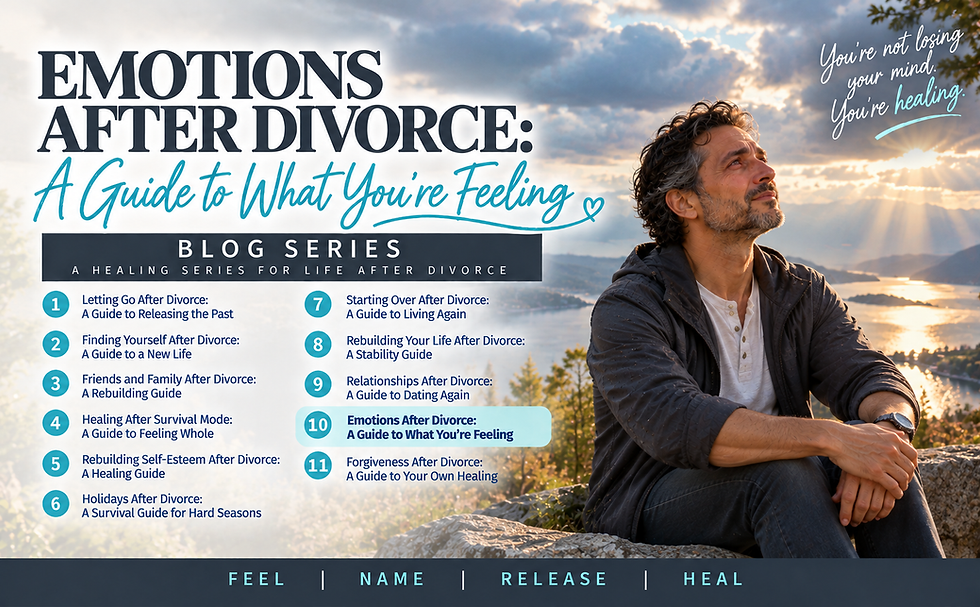
Understanding the Emotional Storm of Divorce
There is a reason people call divorce an emotional storm.
One minute you feel calm, even hopeful. The next, a song on the radio or a photo on your phone knocks the wind out of you. You might wake up angry, feel relieved by lunch, and cry yourself to sleep at night. Some days, you feel nothing at all, and that numbness can be scary too.
If that is your life right now, I want you to hear this clearly: you are not losing your mind. You are going through one of the most painful experiences a human being can face. Divorce ranks near the very top of stressful life events, right alongside the death of a loved one. Your heart, your body, and your mind are all reacting to a huge loss.
When my own marriage of more than twenty years ended, I remember thinking, "Why can't I just get over this?" I was a Navy veteran. I had managed teams and handled hard things. But nothing prepared me for how big and messy the emotions after divorce would feel.
This guide is the starting place for our Emotions of Divorce series. It will help you understand what you are feeling, why it makes sense, and what you can do with each feeling so it does not run your life.
Why Emotions After Divorce Feel So Intense
Divorce is not one loss. It is many losses stacked on top of each other:
The loss of your partner and the relationship you had.
The loss of the future you planned together.
The loss of your home, routines, or financial security.
The loss of time with your kids, if you share custody.
The loss of friends, in-laws, or community connections.
The loss of your identity as a husband, wife, or partner.
Each of those losses brings its own grief. And they often hit at the same time, while you are also dealing with lawyers, money, moving, and parenting. It makes sense that your emotions feel bigger than anything you have felt before.
It also helps to know that emotions after divorce do not follow a neat, orderly path. You might feel several at once. You might think you have moved past one, only for it to come back months later. That is not failure. That is how healing works.
Grief: Why Divorce Can Feel Like a Death
Many people are surprised by how much divorce feels like grief. But in many ways, it is a death. The marriage you had, and the life you thought you would have, has ended.
Grief after divorce can be confusing because the person is still alive. You may still see them, talk to them, or watch them move on. Some people around you may not understand why you are grieving at all, especially if the marriage was unhappy.
You are allowed to grieve, even if you wanted the divorce. You are allowed to grieve even if the marriage was hard. You are grieving the hope, the history, and the dream, not just the person.
Ways to move through grief:
Let yourself cry. Tears are not weakness. They are release.
Talk about the loss with people who will listen without judging.
Write about what you miss and what you do not miss.
Create small rituals of goodbye, like packing up old photos or writing a letter you never send.
Be patient with yourself on anniversaries, holidays, and special dates.
Rejection: When It Feels Like No One Wants You
If your spouse chose to leave, or chose someone else, the sting of rejection can cut very deep. Rejection can make you question your worth, your looks, your personality, and your future.
Rejection often wakes up old wounds from childhood too. If you ever felt unwanted, overlooked, or "not enough" growing up, divorce can make those old feelings come roaring back.
Here is what I want you to remember: one person's choice does not decide your value. Their leaving says more about their limits, choices, and struggles than it does about your worth.
Our post Feeling Abandoned and Rejected: When It Feels Like No One Wants You goes deeper into this painful feeling and how to begin healing it.
Loneliness: When the House Gets Quiet
For many people, loneliness is the emotion that hits hardest after divorce. The house is quiet. There is no one to tell about your day. Weekends without the kids can feel endless. Meals alone can feel heavy.
Loneliness is not just sad. Health experts now recognize that long-term loneliness affects our physical and mental health, raising the risk of depression, anxiety, and other health problems. That is why it matters so much to reach out, even when you do not feel like it.
Small ways to ease loneliness:
Schedule regular calls or visits with friends or family.
Join a support group, class, church group, or volunteer project.
Get out of the house daily, even for a short walk or a coffee shop visit.
Say yes to invitations, even if you only stay a little while.
Learn to enjoy your own company with activities you love.
Being alone and being lonely are not the same thing. Over time, many people learn to enjoy their own company. Our post How to Enjoy Your Own Company – Learning to Be Comfortable Alone After Divorce can help.
Anger: When You Feel Like You Could Explode
Anger after divorce is normal. You may be angry at your ex, at yourself, at the people who took sides, at the court system, or at life itself. Anger often shows up when we have been hurt, treated unfairly, or lost something important.
Anger is not bad. It can tell you that a boundary was crossed or that you deserved better. The problem comes when anger takes over, leaks onto your kids, or keeps you stuck in the past.
Healthy ways to release anger:
Move your body: walk, run, clean, or lift weights.
Write an angry letter you never send.
Talk to someone safe about what made you so angry.
Take a pause before responding to your ex, especially by text.
Notice what the anger is protecting, often hurt or fear.
When anger turns into long-term bitterness, forgiveness can help. Our guide Forgiveness After Divorce: A Guide to Your Own Healing explains how forgiveness can free you without excusing what happened.
Jealousy: When They Move On First
Few things sting like watching your ex move on, especially if they start a new relationship quickly. You may feel jealous of their new partner, their new life, or even how happy they seem on social media.
Jealousy is often a mix of hurt, comparison, and fear that you will be left behind. It is very human. But it can also keep you focused on their life instead of your own.
Ways to cope with jealousy:
Limit or stop checking their social media.
Remind yourself that what you see is a highlight reel, not the full story.
Turn your attention back to your own goals and healing.
Talk about the feeling instead of acting on it.
Celebrate small wins in your own life.
Fear and Anxiety: When the Future Feels Uncertain
After divorce, the future can feel like a giant question mark. Will I be okay financially? Will my kids be okay? Will I be alone forever? Can I really do this on my own?
That uncertainty can turn into anxiety. You might notice racing thoughts, trouble sleeping, a tight chest, stomach problems, or constant worry. Anxiety is your body's way of trying to protect you, but when it stays on high alert, it wears you down.
Helpful ways to calm anxiety:
Breathe slowly, in through your nose and out through your mouth, for a few minutes.
Break big worries into small, doable steps.
Limit news and social media when you feel overwhelmed.
Keep a simple daily routine to create a sense of safety.
Talk to a counselor or doctor if anxiety is affecting your daily life.
Hopelessness and Depression: When You Cannot See a Way Forward
Sometimes the emotions after divorce turn into something heavier. You might feel hopeless, empty, or unable to enjoy anything. You might sleep too much or too little, stop eating or overeat, or have trouble getting out of bed.
Depression is not a character flaw, and it is not something you can just "snap out of." It is a real health condition, and it is treatable. If sadness or hopelessness lasts for more than two weeks, or makes it hard to work, parent, or take care of yourself, please talk to a doctor or mental health professional.
If you ever have thoughts of harming yourself, please call or text 988 in the United States to reach the Suicide & Crisis Lifeline, or go to the nearest emergency room. You do not have to wait until it gets worse. You deserve help right now.
Relief, Peace, and Even Joy
Not every emotion after divorce is painful. Many people also feel relief, especially if the marriage was full of conflict, betrayal, or loneliness. You may feel peace in your quiet home. You may feel moments of joy, freedom, or excitement about the future.
Sometimes these good feelings come with guilt. "How can I feel happy when my family is broken?" Please let yourself feel the good moments. They are not a betrayal of your loss. They are signs of healing.
How to Work With Your Emotions Instead of Against Them
You cannot make your emotions disappear. But you can learn to work with them so they do not take over. Here is a simple process I use and teach:
Name it. Say to yourself, "I am feeling angry," or "This is grief." Naming a feeling helps calm it.
Normalize it. Remind yourself, "It makes sense that I feel this way after everything that happened."
Notice it in your body. Where do you feel it? Your chest, your stomach, your shoulders?
Give it a healthy outlet. Talk, write, move, cry, pray, or create.
Choose your next step. Ask, "What do I need right now?" Then do one small thing to meet that need.
Journaling can be especially helpful. Writing about your emotions gets them out of your head and onto the page, where they often feel more manageable.
Helping Your Children With Their Feelings
If you have children, they are riding out their own emotional storm. Kids may feel sad, angry, scared, guilty, or confused, and they often do not have the words to explain it. Their feelings may show up as tantrums, slipping grades, trouble sleeping, clinginess, or pulling away.
Here are some ways to help:
Tell them often that the divorce is not their fault.
Let them know all of their feelings are okay, even anger.
Keep routines as steady as you can.
Do not ask them to carry adult worries or pick sides.
Give them safe ways to express feelings, like drawing, journaling, or talking at bedtime.
Get help from a school counselor or therapist if you are worried.
One of the best things you can do for your children is take care of your own emotions after divorce. When they see you name your feelings, cope in healthy ways, and keep going, they learn that hard feelings can be survived.
When Emotions Hit at the Worst Times
Feelings do not wait for a convenient moment. They can show up at work, in the school pickup line, or in the middle of a family dinner. When that happens, step away for a minute if you can, breathe slowly, and remind yourself that you can come back to the feeling later, when you are somewhere safe.
Be Gentle With Yourself
Healing from the emotional storm of divorce takes time. There will be days when you feel strong and days when you feel like you are back at the beginning. Both are part of the journey.
Treat yourself like you would treat a dear friend going through the same thing. Rest when you are tired. Eat real food. Move your body. Reach out when you are lonely. Ask for help when you need it.
The storm does not last forever. Slowly, the waves get smaller and farther apart. And one day you will notice that you have weathered the worst of it, and you are still standing.
Posts in This Series
This series is growing. Each new post will take one emotion and walk through it with you. Start here, and check back as new posts are added.
Where to Go From Here
The emotions after divorce are easier to carry when you do not carry them alone. At Surviving Life Lessons, we believe in life survivors helping life strugglers. Our Depression Support Group is a safe place for the heavy days, and our Loneliness & Isolation Support Group understands how quiet life can feel after a marriage ends. You can also browse our Community Groups Catalog to find every group that fits where you are right now.
Next, read Feeling Abandoned and Rejected: When It Feels Like No One Wants You or How to Forgive Rejection and Other Painful Feelings After Divorce.
Your Story Matters
We need your nice comments below! Your thoughts, experiences, and lessons learned might be exactly what someone else needs to hear today.
Drop a comment, Say Hello, and join the conversation.
Need More Personalized Support?
Everyone's journey is unique. If you're looking for personalized guidance, encouragement, or one-on-one support, explore our services to find the option that's right for you. We're here to help you take your next step with confidence and hope.
Helpful Resources for Your Journey
Explore our collection of books, journals, coloring books, and printable PDFs designed to encourage, inspire, and support you every step of the way.
References
HelpGuide. Dealing with a Breakup or Divorce. helpguide.org
National Institute of Mental Health. Depression. nimh.nih.gov
U.S. Surgeon General. Our Epidemic of Loneliness and Isolation. hhs.gov
SAMHSA. 988 Suicide & Crisis Lifeline Fact Sheet. samhsa.gov
About the Author:
Deborah Ann Martin is the founder of Surviving Life Lessons, a published author, poet, speaker, and trainer with over 20 years of management experience across multiple industries. An MBA graduate, U.S. veteran, single mother, and rare cancer survivor, Deborah brings both professional expertise and lived experience to her writing on resilience, leadership, personal growth, and overcoming adversity. Her mission is to empower others with practical wisdom and real-life insight to navigate life’s challenges with strength and purpose.


Comments