

Choose Your Writing Path With AI: Income, Impact, or Legacy

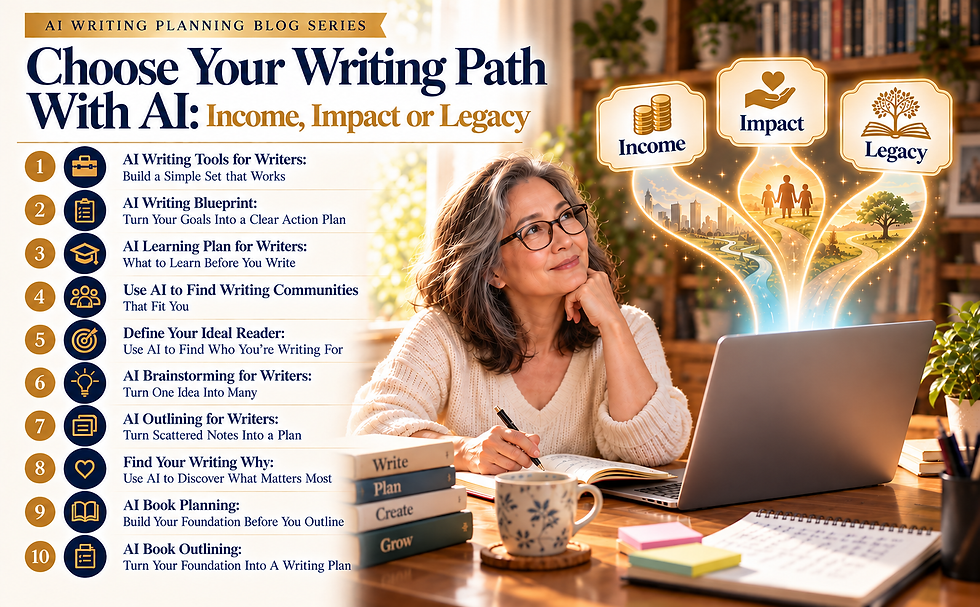
Your Writing Path With AI Starts With What You Want Your Words to Do
Before you spend months writing a book, building a blog, creating poems, or planning a course, there is one question worth answering: What do you want your writing to do? Some people want to earn money. Some want to teach, advocate, or support a cause. Some want to leave stories for their children and grandchildren. Others simply want the joy of creating. Many writers want more than one of these things.
This is your writing path. It is not the same as your genre, and it is not the same as your publishing method. Your path is the larger reason you are doing the work and the result you hope the work will create. When you know that first, many later choices become easier.
AI can help you reach that answer faster by asking questions, comparing options, organizing what you say, and showing you where your goals may conflict. It should not decide what matters to you. Your values, memories, ambitions, and reasons still belong to you.
This article is part of Stage 1: Dream in the Comprehensive 12 Steps for Writing. Stage 1 is about doing the thinking and planning before the real drafting begins, so you can spend more of your time on the writing you actually want to create.
A Writing Path Is Bigger Than a Publishing Path
Writers are often asked whether they want to self-publish or traditionally publish. That can matter later, but it is not the first question. A person may write a family history that is never sold. A nonprofit may create a guide that is given away. A business owner may write a book mainly to build trust with clients. A poet may want publication, but not expect poetry income to replace a job.
If you start by choosing a publishing method, you may be solving the wrong problem. Start with purpose. Then ask what format, audience, genre, and delivery method fit that purpose.
The Main Writing Paths to Explore With AI
You do not have to fit into one box. The purpose of these paths is to give you language for what you are trying to accomplish. Once you can name your primary goal and secondary goals, AI can help you build a more useful plan.
Income: You want writing to produce money directly or support another source of income.
Impact: You want to teach, advocate, encourage, inform, change minds, or help a community.
Legacy: You want to preserve stories, memories, knowledge, family history, values, or lessons for the future.
Personal fulfillment: You want to create because writing is meaningful, enjoyable, healing, challenging, or important to you.
Hybrid: You want two or more of these goals to work together.
Writing for Income
If money is part of your goal, get more specific. Saying, 'I want to make money writing,' is too broad to guide a real plan. Do you mean a full-time writing job? Freelance assignments? Book royalties? Paid newsletters? Speaking? Workshops? Coaching? A book that helps bring clients into an existing business? Those are different paths with different risks, timelines, skills, and measures of success.
The U.S. Bureau of Labor Statistics reports a median annual wage of $72,270 for writers and authors in May 2024. That number describes the broad occupation of writers and authors. It is not a promise of what someone will earn from a book. The Authors Guild's 2023 Author Income Survey reported that full-time authors had a median of $10,000 in book income for 2022 and $20,000 when book and other author-related income were combined. Those sources measure different things, which is exactly why a writer should define the kind of income they mean instead of using one number as a prediction.
AI can help you build an income map. It can ask which forms of writing you enjoy, what skills you already have, whether you want clients, whether you want to sell products, and how much time you can invest. It can then organize possible income paths for you to research. It should not promise that a certain genre, platform, or business model will make you profitable.
Writing for Impact
Impact means the work is meant to do something for other people. You may want to help patients understand a diagnosis, encourage people after divorce, teach children about money, support a nonprofit mission, share faith, advocate for policy change, train employees, or help readers feel less alone.
A writing project created for impact may earn money, but money may not be the main measure. Success might mean the guide is used by 200 families. It might mean a workshop helps people take one practical next step. It might mean a nonprofit can explain its mission more clearly. It might mean a reader says, 'I finally understood what to do.'
AI is useful here because it can keep asking, 'What change do you want the reader to experience?' That question can move a project from a vague wish to a clear purpose. The writer still decides whether the goal is education, encouragement, persuasion, action, awareness, or something else.
Writing for Legacy
Legacy writing is easy to underestimate because it may not come with sales goals or a public launch. Yet it can be some of the most valuable writing a person creates. A legacy project may preserve a family story, military service, cultural traditions, recipes, letters, memories, faith, lessons learned, or the history of a community.
The Library of Congress explains that personal accounts can capture a sense of a place and time and later help people understand the past. Its family history resources also encourage people to preserve stories, photographs, documents, and conversations so they can be shared with future generations.
If legacy is your path, AI can help you create interview questions, make a timeline, identify missing years, organize family names, sort themes, and build a list of stories you still want to capture. Be careful with private information. Family history can include other people's stories too, so think about what is yours to share, what needs permission, and what should remain private.
Writing for Personal Fulfillment
Not every piece of writing needs to become a product. You are allowed to write because you love it. You may want to write poetry, keep a journal, create stories for your own enjoyment, write fan fiction, record memories, or challenge yourself to finish a novel even if you never sell it.
This path matters because pressure can change the experience of writing. If every poem has to become content and every story has to become income, some writers lose the joy that made them start. AI can help protect your creative time by organizing schedules, tracking ideas, and handling planning tasks so the writing itself stays yours.
Most Writers Have a Hybrid Path
A primary path does not mean you must give up every other goal. It simply tells you which goal should win when two goals pull you in different directions.
A memoir writer might say, 'My primary goal is legacy. My second goal is helping people who have lived through similar experiences. If the book earns money later, that is welcome, but I will not remove important family history simply because someone tells me it is less commercial.'
A business writer might say, 'My primary goal is income through consulting and training. Book royalties are secondary. The book needs to clearly show my method and help readers trust my expertise.'
A nonprofit leader might say, 'My primary goal is impact. We want families to understand a difficult issue and know where to get help. We may sell some materials to cover costs, but accessibility matters more than profit.'
These statements are useful because they tell the writer what to protect. AI can help you uncover those priorities, but you should be the person who chooses them.
Use AI as an Interviewer Before You Choose Your Path
One of the best ways to use AI at this stage is to ask it to interview you instead of asking it for an answer. An interview slows the process down enough for your reasons to come forward while still saving you the work of building every question yourself.
Interview me one question at a time to help me choose my writing path. Explore income, impact, education, advocacy, nonprofit work, business growth, personal fulfillment, creative expression, and legacy. Ask follow-up questions when my answer is vague. Do not decide for me. At the end, summarize my primary goal, secondary goals, what success may look like, and any conflicts I still need to resolve.
The 'one question at a time' instruction matters. If AI gives you twenty questions at once, it can start to feel like homework. A conversation lets you notice which questions make you excited, uncomfortable, unsure, or suddenly clear. Those reactions can tell you something important about your real goal.
Ask What Success Would Look Like Before You Start
Writers often set goals that are outside their control. 'Become a bestseller' depends on readers, distribution, timing, marketing, competition, and many other factors. 'Finish a useful first draft for parents of newly diagnosed children' is much more within the writer's control.
AI can help you separate outcome goals from process goals. Outcome goals describe what you hope happens after the work reaches people. Process goals describe what you can do to create strong work and put it in a position to succeed.
Income success might include reaching a certain amount of paid work, developing a service, building a client pipeline, or earning royalties over time.
Impact success might include reader action, workshop participation, downloads, classroom use, community reach, or useful feedback.
Legacy success might mean completing family interviews, preserving photographs, producing printed copies for relatives, or recording stories before they are lost.
Personal success might mean finishing the project, writing consistently, learning a craft, or creating something you are proud to keep.
Your Audience Changes When Your Writing Path Changes
George Mason University's Writing Center explains that audience and purpose affect content, organization, word choice, style, and genre. That is why choosing your path before writing matters. The same subject can become very different projects depending on who needs it and why.
Imagine someone wants to write about caring for an aging parent. A legacy project may be written for children and grandchildren and include personal memories. An impact project may become a practical guide for caregivers. An income project may become a book, workshop, newsletter, or coaching resource. The subject is similar, but the audience and promise are different.
AI can help you compare those versions. Give it the same idea, then ask how the audience, format, tone, research needs, and measures of success might change under each writing path. Use the comparison to think, not to let AI pick your future.
Decide Who Benefits and Who May Pay
For some projects, the reader and the buyer are the same person. For others, they are not. A children's book may be read by a child but purchased by a parent, grandparent, school, or library. A nonprofit guide may be used by families but funded by donors or grants. A business book may be purchased by an employee but paid for by an employer.
This question is especially important if income is part of your path. AI can help you list the possible reader, buyer, sponsor, client, employer, donor, or organization involved in the project. Then you can research which relationships are real instead of assuming the person who needs the writing will also be the person who pays for it.
Let AI Help You Build a Writing Path Scorecard
If you are torn between several paths, ask AI to build a simple scorecard using your own priorities. You might rate each option from 1 to 5. The purpose is not to turn your life into a math problem. The numbers simply make your thinking visible.
How excited am I to do this work?
How strongly does it match my values?
How important is income to this project?
How important is helping or educating other people?
How important is preserving something for the future?
How much time can I realistically give it?
What skills do I already have?
What skills or research would I need?
How private or emotionally difficult is the material?
Would I still want to create it if the money, audience, or attention were smaller than I hoped?
That last question can be powerful. If the answer is yes, you may have found a deeper reason for writing. If the answer is no, that does not make the goal wrong. It simply tells you that income, reach, recognition, or another outcome is more important than you first admitted.
Do Not Let AI Turn Your Writing Path Into a Prediction
AI can sound certain even when it is guessing. It may tell you a genre is profitable, that a certain audience is growing, or that a platform is best for your project without having reliable current evidence. NIST's Generative AI Profile addresses risks connected with generative AI and the need to manage those risks. For a writer, one simple rule is to verify important facts before building a business or life decision around them.
Ask AI to separate facts, assumptions, questions, and items that need research. When it gives you market numbers, income claims, audience statistics, platform rules, grant information, or legal guidance, go to the original source. AI is useful for making the research list. It should not be the final source of truth.
Common Writing Path Mistakes AI Can Help You Catch
Chasing a popular trend even though you do not want to spend months writing it.
Saying you want income without deciding whether that means employment, freelance work, products, royalties, services, or business growth.
Calling a project nonprofit and assuming that means nobody can be paid for the work.
Assuming legacy writing has no audience beyond your family when it may also hold community or historical value.
Trying to serve every possible reader instead of choosing a primary audience.
Letting AI create your mission statement before you have explained what matters to you.
Treating your first decision as permanent. A writing path can change as the project and your life change.
Create Your One-Sentence Writing Path Statement
Once you have answered the questions, ask AI to organize your own words into a short working statement. Do not worry about making it beautiful. It is a planning tool, not a slogan.
I am creating (type of writing) primarily to (main goal) for (primary audience). Success would mean (measure that matters to me). My secondary goal is (secondary goal). I am willing to (tradeoff), but I do not want to sacrifice (important value or boundary).
For example, a writer might say: 'I am creating a family memoir primarily to preserve our story for my children and grandchildren. Success means finishing a clear, honest book that includes the stories I do not want lost. My secondary goal is helping other families talk about hard seasons. I am open to selling the book later, but I do not want commercial pressure to control which memories matter.'
Another writer might say: 'I am creating a practical management book primarily to support my training and consulting business. Success means readers can use the method and organizations see the value of my training. Book royalties are welcome, but they are not the only income goal.'
Your Writing Path Should Guide the Rest of Stage 1
This article does not finish your prewriting work. It gives the rest of that work direction. Once you know your writing path, you can make stronger decisions about your intended reader, genre, age level, reading level, research, tone, format, learning plan, tools, community, schedule, and outline.
That is why this step belongs before the book foundation and outline. An outline answers, 'How should I organize this project?' Your writing path answers the earlier question: 'What am I trying to accomplish in the first place?'
Writing Suggestions: Explore Your Path on Paper First
Before asking AI to summarize you, spend a few minutes writing your own answers. You do not need complete sentences. The point is to hear yourself before you hear the machine.
If nobody ever paid me for this project, would I still want to create it? Why or why not?
If only ten people ever read it, which ten people would I most want to reach?
What do I hope changes for the reader after they finish?
What do I want my family, community, clients, students, or readers to remember from my work?
What would make me feel that the time I spent writing was worthwhile?
Which matters most for this project: income, impact, legacy, personal fulfillment, or a mix?
What am I unwilling to sacrifice just to gain more readers or money?
10 AI Prompts to Help You Choose Your Writing Path
Interview me one question at a time to help me determine whether my main writing goal is income, impact, legacy, personal fulfillment, or a hybrid. Do not choose for me.
I am going to describe the writing project I am thinking about. Ask me what I want the project to do for me, for readers, and for the future. Keep asking until my answer is specific.
Help me separate my primary goal from my secondary goals. Show me where the goals support each other and where they may compete.
If income is important to me, ask what kind of income I mean: employment, freelance work, royalties, speaking, teaching, services, business growth, or another source. Do not make earnings promises.
If impact is important to me, help me define a change I hope the reader will experience. Give me questions, not a mission statement written for me.
If legacy is important to me, help me list the memories, people, documents, photographs, interviews, traditions, and lessons I may want to preserve. Mark privacy or permission questions separately.
Create a writing path scorecard using criteria I choose. Let me rate each option myself, then summarize what the scores seem to reveal without making the decision for me.
Compare how the same writing idea might change if my primary goal were income, impact, legacy, or personal fulfillment. Compare audience, format, tone, research needs, and measures of success.
Review my writing path statement and ask me five questions that would make it clearer. Do not rewrite it until I answer.
Summarize my final writing path in one short planning statement using only information I gave you. Then list the next Stage 1 decisions I still need to make before I begin drafting.
Free and Paid Resources and Tools
You do not need expensive tools to choose your writing path. A notebook, index cards, a basic document, a spreadsheet, library resources, and the free tier of an AI tool may be enough to work through your goals. University writing centers such as George Mason University also provide free guides on audience, purpose, genre, and responsible AI use.
Paid options may be useful if you want deeper support. These can include professional writing organizations, writing coaches, career coaches, business mentors, editors, market research tools, paid AI plans, courses, or workshops. Pay for help because it solves a clear problem, not because you feel a 'real writer' must own more tools.
If money is part of your writing path, professional organizations can also help you learn more about contracts, author income, business practices, and the realities of earning from writing. Always check current membership details and costs directly with the organization.
Continue the Conversation in Our Writing Groups
A writing path can become clearer when you say it out loud and hear how other writers describe their goals. Visit the Surviving Life Lessons writing groups to connect with other people who are planning, learning, and creating. You do not have to figure out every part of your writing journey alone.

Your Story Matters
We need your nice comments below! Your thoughts, experiences, and lessons learned might be exactly what someone else needs to hear today.
Drop a comment, Say Hello, and join the conversation.
Need More Personalized Support?
Everyone's journey is unique. If you're looking for personalized guidance, encouragement, or one-on-one support, explore our services to find the option that's right for you. We're here to help you take your next step with confidence and hope.
Helpful Resources for Your Journey
Explore our collection of books, journals, coloring books, and printable PDFs designed to encourage, inspire, and support you every step of the way.
References
George Mason University Writing Center: "Rhetoric", https://writingcenter.gmu.edu/writing-resources/general-writing-practices/rhetoric
George Mason University Writing Center: "Write a Prompt for Gen AI", https://writingcenter.gmu.edu/writing-resources/gen-ai-and-writing/write-a-prompt-for-gen-ai
George Mason University Writing Center: "Using Gen AI in Your Writing Process", https://writingcenter.gmu.edu/writing-resources/gen-ai-and-writing/using-gen-ai-in-your-writing-process
U.S. Bureau of Labor Statistics. “Writers and Authors.” Occupational Outlook Handbook. https://www.bls.gov/ooh/media-and-communication/writers-and-authors.htm
The Authors Guild: "Key Takeaways from the Authors Guild’s 2023 Author Income Survey", https://authorsguild.org/news/key-takeaways-from-2023-author-income-survey/
Library of Congress. “Personal Narrative.” Collecting Memories: "Treasures from the Library of Congress", https://www.loc.gov/exhibitions/treasures-from-the-library-of-congress/about-this-exhibition/personal-narrative/
Library of Congress: "Write Your Family History – And Send it to the Library of Congress!", https://blogs.loc.gov/loc/2014/01/write-your-family-history-and-send-it-to-the-library-of-congress/
Library of Congress: "Preserving Family Documents, Artifacts and More. Family History for Kids", https://guides.loc.gov/family-history-for-kids/preservation
National Institute of Standards and Technology. Autio, Chloe, Reva Schwartz, Jesse Dunietz, Shomik Jain, Martin Stanley, Elham Tabassi, Patrick Hall, and Kamie Roberts. “Artificial Intelligence Risk Management Framework: Generative Artificial Intelligence Profile.” https://www.nist.gov/publications/artificial-intelligence-risk-management-framework-generative-artificial-intelligence
About the Author:
Deborah Ann Martin is the founder of Surviving Life Lessons, a published author, poet, speaker, and trainer with over 20 years of management experience across multiple industries. An MBA graduate, U.S. veteran, single mother, and rare cancer survivor, Deborah brings both professional expertise and lived experience to her writing on resilience, leadership, personal growth, and overcoming adversity. Her mission is to empower others with practical wisdom and real-life insight to navigate life’s challenges with strength and purpose.


.png)
Comments