

Working Through Chemotherapy Cost Me the Rest My Body Needed

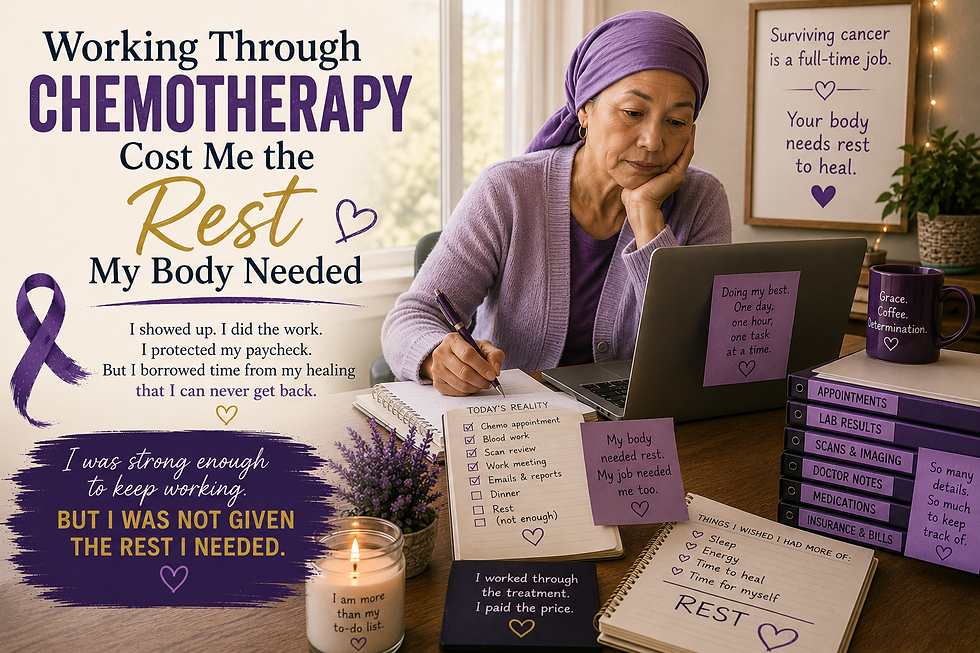
Working During Chemotherapy: Flexible Hours Protected My Paycheck, but They Did Not Create More Energy
I continued working while receiving doxorubicin chemotherapy.
My employer allowed me to flex my work schedule around treatments, bloodwork, scans, and medical appointments. That accommodation helped me protect my job and continue receiving my income.
I was grateful for it.
I was also exhausted.
Flexible hours allowed me to move work to evenings and weekends. They did not remove the work or give my body more hours to recover.
I Still Needed My Paycheck
Cancer did not stop my regular expenses.
I still had a home to maintain.
I still had utilities, insurance, groceries, transportation, and family responsibilities.
At the same time, cancer added deductibles, medical bills, gasoline, vitamins, delivery fees, prescriptions, and many other expenses.
I could not treat employment as optional simply because chemotherapy made working difficult.
My paycheck helped support my household and pay for the care that was keeping me alive.
Surgery and Chemotherapy Affected Work Differently
When I had major surgery, I used short-term disability.
The benefit replaced approximately 60 percent of my usual pay.
That support gave me time away from work to recover, but it also meant losing about 40 percent of my normal income at the same time my medical expenses were increasing.
During chemotherapy, I remained at work and used schedule flexibility.
That protected more of my income.
It also meant much less recovery time.
Neither choice was easy.
Working During Chemotherapy Is Not Possible for Everyone
Some people can continue working during chemotherapy, while others cannot.
The answer depends on the treatment, side effects, type of work, infection risk, schedule, health conditions, and support available. The National Cancer Institute notes that some patients can continue working if their schedules are adjusted according to how they feel, including part-time work or remote work when the job permits it.
A person who continues working is not necessarily stronger than someone who takes leave.
A person who takes leave is not giving up.
Each patient has a different body, job, treatment, financial situation, and medical need.
Doxorubicin Did Not Fit Neatly Into a Workweek
Chemotherapy happened in cycles.
I had the treatment.
Then I waited to see how my body would react.
There were days when symptoms were stronger and days when I could function better.
Appointments could include:
* Laboratory work
* Oncology visits
* Infusions
* Port care
* Imaging
* Primary-care appointments
* Follow-up for complications
Those appointments did not always happen outside normal work hours.
I had to place them somewhere inside a week that already contained a full-time job.
Flexible Scheduling Sounded Like the Perfect Solution
On paper, flexible scheduling solved the conflict.
I could attend the appointment and make up the time later.
If I lost several hours during the week, I could work in the evening.
I could use Saturday or Sunday.
I could adjust the beginning or end of the day.
The work still got done.
The appointments still happened.
The arrangement helped me remain employed.
The part missing from that equation was rest.
Work Hours Moved Into Recovery Hours
After treatment, my body needed time.
It needed sleep.
It needed food.
It needed fluids.
It needed relief from nausea, fatigue, pain, and mental fog.
Instead, some of the hours that might have been used for recovery became makeup work.
If I spent part of a weekday at the cancer center, I could not simply erase those work hours.
I moved them.
They often landed on the weekend.
A Weekend Was No Longer a Weekend
Before cancer, a weekend might include errands, household tasks, cooking, family time, or rest.
During chemotherapy, a weekend could become the place where unfinished work hours went.
I might be trying to recover physically while also meeting professional expectations.
I still had household responsibilities.
I still needed to organize appointments and medicines.
The weekend was not automatically available for healing.
It became another working period.
Cancer Fatigue Is Not Ordinary Tiredness
Cancer-related fatigue can be physical, emotional, and mental. It may not improve completely with ordinary sleep and can interfere with daily functioning. NCI reports that fatigue is extremely common during chemotherapy and radiation treatment.
I was not simply tired because I had worked a long day.
My body was processing powerful treatment.
I was healing from surgery.
My blood counts and nutrition were being affected.
Food tasted bad.
I had medical stress, poor sleep, and fear.
Then I asked that same body to continue performing at work.
Fatigue Affected More Than My Muscles
Fatigue affected my muscles, and it also affected other areas of my life.
Fatigue could affect:
* Concentration
* Memory
* Patience
* Motivation
* Decision-making
* Communication
* Physical stamina
* The ability to sit comfortably
* The ability to recover after an appointment
I still had to complete work that required thought and accuracy.
Mental exhaustion mattered just as much as physical weakness.
Cancer-related cognitive problems may be affected by treatment, fatigue, stress, pain, sleep, and other health issues.
I Had to Plan Work Around My Better Hours
I began paying attention to when I functioned best.
Some hours were better for detailed or complicated work.
Other times were better for routine tasks.
If an appointment or treatment drained me, I might not be able to return immediately to high-level work.
I had to organize tasks according to the energy and concentration I had available.
That required flexibility from me as well as from my employer.
Keeping My Job Preserved Part of My Identity
Work was not only about money.
It was one part of my identity.
Cancer had already turned me into a patient.
Continuing to work reminded me that I was still knowledgeable, productive, and capable.
I could still solve problems.
I could still contribute.
I could still be more than my diagnosis.
That sense of normalcy had value.
Work Also Gave My Mind Somewhere Else to Go
Cancer can take over every conversation and thought.
Work gave me subjects that were not tumors, scans, medicine, or survival.
There were tasks to complete.
There were systems to support.
There were coworkers and responsibilities.
For part of the day, I could focus on something outside my body.
That did not remove cancer.
It gave my mind occasional distance from it.
Productivity Can Hide Illness
Because I kept working, people could assume I was functioning normally.
I could answer emails, attend meetings, and complete tasks while feeling physically terrible.
A person may look capable on a computer screen and still be dealing with nausea, fatigue, pain, mental fog, and fear.
Work performance does not show the full cost of producing that work.
I could complete the assignment.
Others did not see how long I needed to recover afterward.
Being Able to Work Did Not Mean I Was Well
There is a dangerous assumption that if a patient is working, the illness must not be severe.
People may think:
“She is working, so she must be doing fine.”
I had Stage IV uterine leiomyosarcoma.
I underwent major surgeries.
I was receiving doxorubicin.
I developed pneumonia.
I had a port complication and a postsurgical seroma.
I continued working because my circumstances and accommodations allowed me to keep going.
I kept working because I had no other means to support myself.
That did not make the cancer minor.
I Did Not Want to Be Viewed as Unreliable
Serious illness can create anxiety about how an employee will be perceived.
Will coworkers believe I cannot handle important responsibilities?
Will a supervisor stop including me in future plans?
Will people assume I am leaving?
Will every mistake be blamed on cancer?
Will I lose advancement opportunities?
I wanted to be honest about my needs without allowing the diagnosis to erase everything I had achieved professionally.
I Needed Accommodations, Not Lower Expectations About My Ability
An accommodation changes how work is completed so a qualified employee can continue performing essential duties.
Depending on the job and the individual, accommodations related to cancer may include schedule changes, breaks, time for appointments, remote work, leave, or changes to the work environment. The EEOC explains that reasonable accommodations may be required for limitations caused by cancer or its treatment, unless they create an undue hardship for the employer.
I needed flexibility.
I did not need people to assume that I had lost my knowledge or professional value.
Accommodations Do Not All Look the Same
One employee may need remote work.
Another may need a later start time.
Someone else may need:
* Intermittent leave
* A reduced schedule
* More frequent breaks
* Time for medical appointments
* A nearby restroom
* Permission to sit
* Ergonomic equipment
* Temporary reassignment of marginal tasks
* A quieter place to concentrate
The accommodation must fit the employee’s limitations and job.
What worked for me may not be enough for another person.
Flexible Hours Were Helpful but Incomplete
My schedule flexibility solved the problem of being physically absent for an appointment.
It did not automatically solve:
* Fatigue
* Recovery
* Mental fog
* Pain
* Infection risk
* Emotional distress
* Household responsibilities
* Transportation time
An accommodation can help while still leaving a serious burden.
Employees and employers may need to revisit an arrangement when treatment effects change.
I Sometimes Paid for Flexibility With My Health
When I used weekends to make up work, I protected my paycheck.
I may also have reduced my body’s opportunity to recover.
I cannot measure exactly what more rest would have changed.
I know I often had little time when I was not working, attending appointments, traveling, managing medical information, or handling everyday responsibilities.
The body cannot always distinguish between paid work and unpaid medical work.
Both use energy.
Appointments Were Work Too
A cancer appointment was not rest.
It could involve:
* Driving more than an hour
* Parking
* Walking into the cancer center
* Waiting
* Blood draws
* Medical discussions
* Treatment
* Side effects
* Driving home
* Calls and paperwork afterward
Taking time away from my job for treatment did not mean I had received time off.
I had completed a different kind of work.
Medical Leave and Disability Benefits Are Different
Job-protected leave, paid sick leave, short-term disability, and workplace accommodations are not the same thing.
Federal FMLA may provide eligible employees of covered employers with unpaid, job-protected leave for qualifying medical reasons while maintaining group health coverage under certain conditions. Leave may sometimes be taken intermittently or on a reduced schedule when medically necessary.
Short-term disability is generally an income-replacement benefit governed by the particular employer or insurance plan.
An accommodation may allow someone to keep working with adjustments.
A patient may use more than one form of protection or benefit, depending on eligibility and the situation.
Job Protection Does Not Automatically Provide Income
Unpaid leave may protect a job without paying the household expenses.
That distinction matters.
A patient may medically need time away but be financially unable to take it.
A disability policy may replace only part of the paycheck.
Paid leave may be limited.
The employee may keep working because the family cannot survive without the income.
From the outside, that may look like commitment or strength.
Inside the household, it may be financial necessity.
Short-Term Disability Replaced Only Part of My Pay
For my surgeries, short-term disability paid approximately 60 percent of my wages.
That was much better than receiving nothing.
It still left a large gap.
My expenses did not fall to 60 percent.
Cancer costs were increasing.
I had to weigh physical recovery against financial survival.
That experience influenced how I approached work during chemotherapy.
I Was Trying to Protect My Future Too
Leaving work can affect more than the current paycheck.
Depending on the job and benefit plans, it may affect:
* Health insurance
* Retirement contributions
* Paid leave balances
* Seniority
* Future earnings
* Career opportunities
* Disability coverage
* Life insurance
I was thinking about today and the future.
Cancer had already made the future uncertain.
I did not want employment loss to make it even more unstable.
Coworker Support Made a Difference
My coworkers did more than adjust to my schedule.
They helped with meals.
They contributed to a wig and hat fund.
They showed care in practical ways.
That support helped me feel that I remained part of the workplace rather than becoming a problem the workplace had to manage.
Small actions can change how safe an ill employee feels.
Privacy at Work Can Be Complicated
Employees may need to share enough medical information to request leave or an accommodation.
They may not want every coworker to know the diagnosis or treatment details.
The person with cancer should have a voice in what is shared.
A supervisor may need to know that an accommodation is approved.
Coworkers may only need to know that the schedule has changed.
A serious diagnosis does not remove an employee’s need for dignity and medical privacy.
I Did Not Want Cancer to Become My Professional Identity
I did not want every interaction to begin with:
“How is the cancer?”
I appreciated concern.
I also wanted people to discuss the work.
I wanted to be included in decisions.
I wanted my knowledge respected.
I wanted opportunities based on my ability, not removed because people were afraid of what might happen to me.
Cancer was part of my life.
It was not my job title.
There Were Days When I Should Have Rested More
Looking back, I can recognize that I pushed myself very hard.
I was trying to maintain income, insurance, responsibilities, and normal life.
There were probably times when my body needed more recovery than I allowed.
I do not say that to criticize the choices I made.
I made them inside real financial and family circumstances.
I say it because other patients should understand that surviving the workweek is not the same as receiving enough rest.
Rest Is Part of Treatment
Rest can sound passive.
During cancer treatment, rest may support:
* Recovery
* Safe movement
* Concentration
* Emotional regulation
* Infection prevention
* Nutrition
* Treatment tolerance
* The ability to complete necessary activities
Rest does not cure cancer.
It helps the body and mind manage what treatment demands.
A patient should not have to prove she deserves rest by becoming completely unable to function.
I Had to Learn the Difference Between Tired and Unsafe
There were days when I was tired but could work.
There were other times when fatigue, medication effects, pain, or mental fog could affect safety and accuracy.
Important questions included:
* Can I concentrate well enough?
* Can I drive safely?
* Am I making unusual mistakes?
* Am I falling asleep during tasks?
* Am I too dizzy or weak?
* Is the fatigue getting worse?
* Could an infection or blood-count problem be contributing?
* Do I need to call the doctor?
Cancer fatigue is common, but new or severe symptoms still need medical evaluation.
Working From Home Does Not Eliminate Fatigue
Remote work can reduce driving, walking, exposure, and preparation time.
It can be very helpful.
It does not make chemotherapy disappear.
A person can work from bed or a home office and still be too sick to work safely or effectively.
Remote access should not become a reason to expect an employee to work through every medical condition.
Sometimes the correct accommodation is still time away.
Intermittent Leave May Fit Treatment Cycles
Some patients do not need one long period away from work.
They may need time for recurring infusions, appointments, recovery days, or unpredictable symptom flares.
For eligible employees, FMLA can sometimes be used intermittently or through a reduced schedule when medically necessary.
The exact rules and paperwork depend on the employee, employer, and medical situation.
Patients should speak with human resources or the appropriate benefits contact rather than assume they are or are not covered.
Medical Certification Creates More Work
Leave and accommodation requests may require medical documentation.
The employee may need:
* A form from human resources
* Certification from a healthcare professional
* Dates or estimated frequency of treatment
* Description of work limitations
* Expected duration
* Follow-up documentation
* Recertification
The Department of Labor provides optional FMLA forms, although employers may use forms that request the same basic information allowed by law.
This becomes another administrative duty during treatment.
Employees May Be Afraid to Ask
A person with cancer may fear that requesting an accommodation will make the employer view her differently.
She may worry about job security.
She may try to hide side effects.
She may use vacation time instead of requesting medical leave.
She may work through unsafe fatigue.
Clear workplace policies and respectful conversations can make it easier to ask before a crisis occurs.
Employers Need Honest Information Too
An employer cannot respond to needs it does not understand.
The employee does not necessarily have to share every detail of the cancer journey.
She may need to explain the functional limitation.
For example:
* I need recurring time for medical treatment.
* I cannot sit continuously for long periods.
* I need additional breaks because of fatigue.
* I need temporary remote work because of infection risk.
* I need a reduced schedule during this treatment period.
The focus can remain on what allows the employee to perform the job.
Accommodations Should Be Reviewed Over Time
Cancer treatment changes.
The accommodation that works during one month may not work later.
Surgery recovery is different from chemotherapy.
Chemotherapy is different from maintenance medicine.
Chronic side effects may require longer-term adjustments.
The employee and employer may need to revisit what is effective.
An accommodation should be a working plan, not a one-time conversation that can never change.
Managers Should Not Compare Employees With Cancer
A supervisor may know another person who worked through treatment.
That comparison is not useful.
Different people have:
* Different cancers
* Different stages
* Different treatments
* Different side effects
* Different jobs
* Different health conditions
* Different financial resources
* Different caregiving support
One employee’s ability to work full time does not prove another employee can safely do the same.
Coworkers May See Only the Accommodation
A coworker may notice that someone has a flexible schedule, works from home, or leaves for appointments.
She may not see:
* The infusion
* The vomiting
* The pain
* The bloodwork
* The long drive
* The mental fog
* The weekend makeup hours
* The financial pressure
* The fear
Workplace resentment can grow when people see the adjustment but not the medical reality.
The employee should not have to reveal private details to earn basic respect.
My Workday Did Not End When I Logged Off
After work, I still had cancer-related tasks.
There were medicines to take.
Appointments to confirm.
Food to manage.
Medical records to organize.
Bills to review.
Symptoms to track.
Calls to return.
Household responsibilities remained.
The end of paid work did not mark the beginning of true rest.
I Was Working Two Jobs
One job paid me.
The other was surviving cancer.
The cancer job included:
* Attending treatment
* Recovering
* Tracking symptoms
* Managing medicines
* Coordinating doctors
* Handling insurance
* Maintaining nutrition
* Monitoring complications
* Researching questions
* Arranging help
Both jobs were demanding.
Only one appeared on my employment record.
The Cost of Working Was Not Always Visible
Working protected:
* Income
* Insurance
* Professional identity
* Routine
* Future employment
It could cost:
* Rest
* Energy
* Family time
* Recovery
* Sleep
* Emotional capacity
* Weekends
There was no simple answer.
I gained something important and gave up something important.
I Do Not Regret Protecting My Income
I made the decisions that seemed necessary at the time.
I was supporting myself and managing enormous healthcare expenses.
I was grateful that I could continue working and that flexibility was available.
I also believe workplaces and patients need to understand the full cost.
Flexibility should not automatically mean every missed hour must be pushed into the patient’s recovery period.
Sometimes the medically responsible answer is actual leave.
What I Would Ask Earlier Now
If I were beginning the process again, I would ask:
* What leave benefits do I have?
* Am I eligible for FMLA?
* Can leave be intermittent?
* Does the employer offer short-term disability?
* How much pay would it replace?
* How are insurance premiums handled?
* Can I work remotely?
* Can I temporarily reduce hours?
* Can deadlines or meeting times be adjusted?
* Who receives medical documentation?
* How will my privacy be protected?
* Can the accommodation be reviewed if treatment changes?
* What happens if I cannot return when expected?
Understanding the options early could reduce last-minute decisions.
Questions to Ask the Medical Team
When unsure of what to ask your medical, below are some suggestions. Ask Questions until you understand. When you are done, remember to thank them.
* How might this treatment affect my ability to work?
* Which days in the cycle may be hardest?
* Is fatigue likely to build over time?
* Are there infection precautions that affect my workplace?
* Can I drive after treatment?
* Should I avoid particular physical tasks?
* What symptoms mean I should not work?
* Can you document my limitations?
* Do I need reduced hours or recovery days?
* Who completes leave or disability forms?
* Could my medicines affect concentration or judgment?
The medical team may not know every detail of the job.
The patient should describe the actual work demands.
Questions to Ask Human Resources
When unsure of what to ask Human Resources, below are some suggestions. Ask Questions until you understand the processes and policies. When you are done, remember to thank them.
* What leave programs apply to me?
* Is the leave paid or unpaid?
* Is short-term disability separate from job-protected leave?
* What documents are needed?
* What are the deadlines?
* Can I use intermittent leave?
* Can I work a reduced schedule?
* How will benefits continue?
* Who will know my medical information?
* How are accommodations requested?
* What happens if the treatment schedule changes?
* How do state protections affect my situation?
Employment rights and benefits vary, so employees may need qualified legal or benefits advice.
How Loved Ones Can Support a Working Patient
Family members may help by:
* Preparing meals
* Handling errands
* Driving to treatment
* Taking over one household responsibility
* Protecting rest after work
* Avoiding unnecessary demands on treatment days
* Helping organize leave paperwork
* Respecting the need for quiet
* Watching for worsening symptoms
A patient who continues working may have little energy left for home.
Support at home can help make the work arrangement possible.
What Employers Can Do Better
A supportive employer can:
* Listen without making assumptions
* Explain leave and accommodation options
* Protect privacy
* Allow appropriate flexibility
* Review the arrangement as treatment changes
* Focus on essential job functions
* Avoid punishing the employee for needing medical care
* Train supervisors
* Prevent coworker harassment or resentment
* Encourage realistic workload planning
The employee should not have to choose between hiding cancer and losing professional respect.
What Coworkers Should Understand
Do not assume the employee is receiving special treatment.
She may be using every available hour to keep working.
Avoid comments such as:
* “It must be nice to leave early.”
* “At least you get to work from home.”
* “You look fine.”
* “I am tired too.”
* “Why are you still talking about cancer?”
The accommodation may be the reason the employee can remain part of the team.
What I Wish Someone Had Told Me
I wish someone had told me that flexible hours would protect my paycheck but could take away much of my recovery time.
I wish I had known that a medical appointment was another form of work, not a rest period.
I wish someone had explained the difference between FMLA, short-term disability, paid leave, and workplace accommodations.
I wish I had known that working successfully could cause people to underestimate how sick I was.
I wish someone had told me that rest was part of managing treatment, not a reward for finishing every task.
I wish I had understood that an accommodation might need to change as the treatment and side effects changed.
Most of all, I wish someone had said:
“Being able to force yourself through the work does not always mean working is the healthiest choice that day.”
Hope for Today
I worked through doxorubicin chemotherapy.
My employer allowed flexible hours.
That flexibility helped me keep my job and income during an extremely expensive time.
I attended treatment and made up the work.
I worked evenings.
I worked weekends.
I kept producing.
From the outside, the plan worked.
Inside my body, the hours had to come from somewhere.
Many of them came from rest.
I do not regret doing what I believed was necessary to support my household.
I do believe patients deserve to understand the tradeoff.
Work can provide income, purpose, a sense of normalcy, and identity.
It can also use the energy the body needs for recovery.
The right decision may change throughout treatment.
Some days, I could work.
Some days, I needed an adjustment.
At other times, especially after surgery, I needed leave.
There is no prize for working until the body collapses.
There is no shame in using the protections and benefits available.
Cancer patients are still employees with skills, knowledge, and value.
They are also human beings receiving difficult medical treatment.
A workplace can respect both truths.
Frequently Asked Questions
Did I work during chemotherapy?
Yes. I continued working while receiving doxorubicin and flexed my schedule around treatment and appointments.
Did flexible scheduling reduce my workload?
No. It moved work into other hours, often evenings and weekends.
Why did I continue working?
I needed income, insurance, professional identity, and financial stability during expensive treatment.
Did I take short-term disability?
Yes. I used it for surgeries, when the benefit replaced approximately 60 percent of my pay.
Is cancer-related fatigue ordinary tiredness?
No. It can be persistent, severe, and not proportional to recent activity. It may interfere with physical, emotional, and cognitive functioning.
Can people work during chemotherapy?
Some can, depending on treatment, side effects, job demands, and accommodations. Others cannot safely continue working.
What workplace adjustments may help?
Possible accommodations can include schedule changes, breaks, leave, remote work, ergonomic changes, or other adjustments based on the employee and job.
Does FMLA pay wages?
Federal FMLA provides eligible workers with qualifying unpaid, job-protected leave. Other paid leave or disability benefits may sometimes run at the same time, depending on the plan.
Can FMLA be used for recurring cancer appointments?
Eligible employees may be able to use FMLA for treatment appointments or intermittently when medically necessary.
Does remote work solve cancer fatigue?
Not always. It may reduce travel and exposure, but the employee may still be medically unable to work.
Should an employee disclose the entire diagnosis?
Not necessarily. The appropriate medical documentation and privacy rules depend on the situation. Employees may need to explain limitations and requested accommodations without sharing every detail with coworkers.
When should fatigue be reported?
New, worsening, severe, or unsafe fatigue should be discussed with the medical team, especially when it affects driving, concentration, balance, breathing, or essential daily activities.
Support on Your Journey
Working during cancer treatment can create a conflict between the body’s need for recovery and the household’s need for income.
Surviving Life Lessons Community Groups are being formed so patients, survivors, caregivers, and working family members can discuss accommodations, leave, fatigue, workplace identity, income loss, and the pressure to keep performing during treatment.
Neighbor Chat offers a quieter place to talk when you are tired of explaining why working does not mean you are well.
Next Step Coaching can help organize questions for healthcare professionals and human resources, document work limitations, and identify the next practical step. It does not replace employment law advice, benefits counseling, medical care, human-resources guidance, union representation, or financial planning.
Flexibility can help a person keep working.
It should not require the person to sacrifice every hour needed to heal.
Your Story Matters
We need your nice comments below! Your thoughts, experiences, and lessons learned might be exactly what someone else needs to hear today.
Drop a comment, Say Hello, and join the conversation.
Find Your Community
No one should have to face life's challenges alone. At Surviving Life Lessons, we believe in life survivors helping life strugglers. Explore our growing Community Groups to connect with others who understand your journey, share encouragement, and find hope through meaningful conversations. You'll also have the opportunity to introduce yourself and share your own story of overcoming. Your story matters. It may be the encouragement someone else needs to keep moving forward, reminding them that they are not alone and that hope is always possible.
Need More Personalized Support?
Everyone's journey is unique. If you're looking for personalized guidance, encouragement, or one-on-one support, explore our services to find the option that's right for you. We're here to help you take your next step with confidence and hope.
Helpful Resources for Your Journey
Explore our collection of books, journals, coloring books, and printable PDFs designed to encourage, inspire, and support you every step of the way.
References
**National Cancer Institute. “Chemotherapy to Treat Cancer.”**
**National Cancer Institute. “Fatigue and Cancer.”**
**National Cancer Institute. “Living With Advanced Cancer for a Long Time.”**
**U.S. Department of Labor. “Workplace Protections for Individuals Impacted by Cancer.”**
**U.S. Department of Labor. “Family and Medical Leave Act.”**
**U.S. Department of Labor. “Taking Leave When You or Your Family Member Has a Serious Health Condition.”**
**U.S. Equal Employment Opportunity Commission. “Cancer in the Workplace and the ADA.”**
**U.S. Equal Employment Opportunity Commission. “Disability Discrimination and Reasonable Accommodation.”**
---
**Disclaimer:** This article shares my personal experience and general educational information. It is not medical, employment, disability, benefits, financial, human-resources, or legal advice. Workplace rights, eligibility, leave, disability benefits, and reasonable accommodations vary by employer, plan, location, and individual circumstances. Consult qualified healthcare professionals, human resources, benefits administrators, union representatives, government agencies, or an employment attorney when appropriate.
About the Author:




.png)
Comments