

SMART Goals for Busy Parents

Updated: Sep 29
Parenting is one of the busiest roles anyone can have. Between work, school schedules, meals, cleaning, appointments, activities, and unexpected moments, it is easy to feel like there is no time left for yourself. Many parents want healthier routines, less stress, more organization, better emotional balance, and stronger family connections, but traditional goal systems assume extra time and energy that parents rarely have.
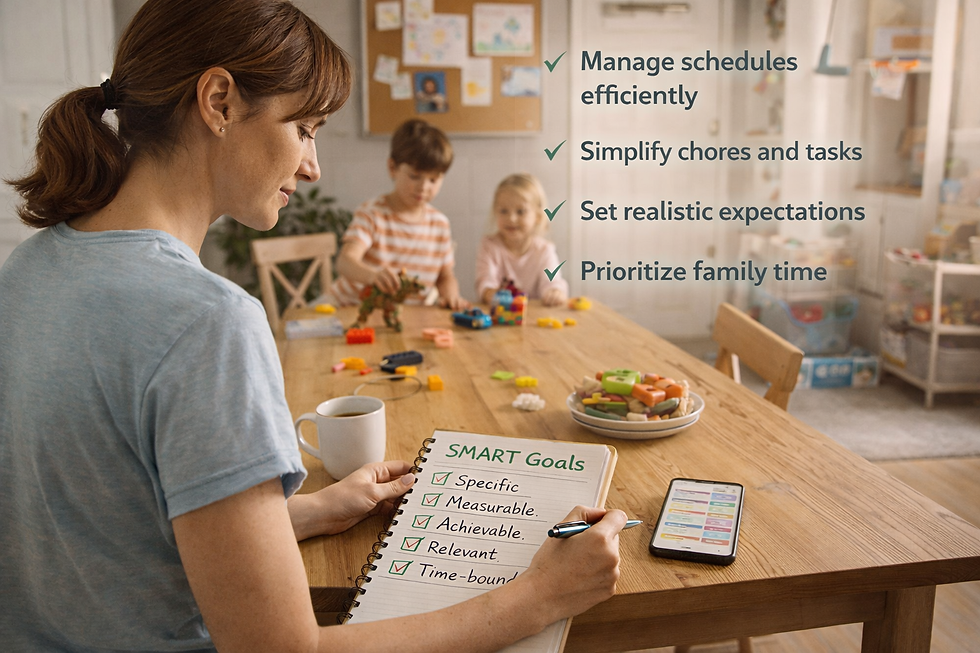
SMART goals help you build routines that fit real life. Instead of huge commitments, you create small, doable steps that work even when mornings are chaotic, schedules change, and exhaustion feels constant.
Why People Are Searching for Help With SMART Goals for Busy Parents
Parents are not searching because they are unmotivated. They are searching because they are overwhelmed and want relief, stability, and structure.
Busy parents often feel:
• exhausted by constant responsibilities
• overwhelmed by schedules, mess, and expectations
• guilty for not doing “enough.”
• stretched between family needs and personal needs
• behind on organization and routines
• emotionally drained but still pushing forward
SMART goals for busy parents provide a realistic way to reduce stress, regain control, and create daily habits that feel supportive rather than exhausting.
Phase One: Creating a Foundation of Stability
Parenting feels calmer when you have simple habits that ground your day.
Step 1: Start the morning with one grounding habit
SMART goal example: “I will drink one full glass of water each morning before breakfast.”
Why it matters: Your needs matter too. Grounding yourself helps stabilize your energy and mood.
How to do it: Keep a cup ready. Drink before the day starts rushing.
Step 2: Build one predictable anchor in your day
SMART goal example: “I will choose one daily anchor such as morning coffee in quiet, a short stretch, or a consistent breakfast routine.”
Why it matters: Predictability helps your nervous system feel safe.
How to do it: Choose something simple. Repeat it daily.
Step 3: Give yourself permission to be human
SMART goal example: “I will remind myself once a day that I do not have to do everything perfectly.”
Why it matters: Parents carry enormous emotional pressure. Self-compassion reduces burnout.
How to do it: Use gentle affirmations like, “I am doing the best I can.”
Step 4: Celebrate what you already do
SMART goal example: “I will acknowledge one thing I handled well each day.”
Why it matters: Your brain needs reminders that you are capable and strong.
How to do it: Say it out loud or write one simple sentence.
Phase Two: Managing Time in Small, Realistic Steps
Time management for parents must be flexible, not rigid.
Step 1: Choose one priority each day
SMART goal example: “I will choose one top priority task each morning and write it down.”
Why it matters: Trying to do everything leads to overwhelm. One priority creates focus.
How to do it: Keep a simple note in your phone or on paper.
Step 2: Create tiny moments of order
SMART goal example: “I will spend three minutes resetting the main living area before bed.”
Why it matters: Small resets prevent chaos from building.
How to do it: Set a timer. Do what you can. Stop when it ends.
Step 3: Reduce overwhelm through tiny planning
SMART goal example: “I will glance at tomorrow’s schedule for one minute each evening.”
Why it matters: Knowing what’s ahead helps your mind relax.
How to do it: Just look. No pressure to fix everything.
Step 4: Build a flexible structure, not strict routines
SMART goal example: “I will create one simple daily rhythm instead of a strict schedule.”
Why it matters: Children, work, and life change constantly. Flexibility keeps routines sustainable.
How to do it: Think flow, not perfection.
Phase Three: Supporting Family Connection
Connection grows through small, meaningful moments.
Step 1: Add a simple connection time with your child
SMART goal example: “I will read with my child for five minutes every weeknight.”
Why it matters: Short, focused time matters more than long, distracted time.
How to do it: No pressure to make it perfect. Just be present.
Step 2: Build consistency into family time
SMART goal example: “I will choose one small family routine such as dinner together, bedtime hugs, or evening check-ins.”
Why it matters: Consistency builds emotional safety.
How to do it: Repeat. Keep it simple.
Step 3: Practice emotional presence
SMART goal example: “I will ask my child one meaningful question each day.”
Why it matters: Children thrive when they feel seen and heard.
How to do it: Questions like: “What was your favorite moment today?”
Step 4: Protect a small piece of peaceful family time
SMART goal example: “I will put my phone down for ten minutes during family time.”
Why it matters: Undivided attention creates a deeper connection.
How to do it: Silence notifications. Be present.
Phase Four: Creating Manageable Household Routines
The organization for parents must be realistic.
Step 1: Declutter in tiny steps
SMART goal example: “I will clean or organize one small item each day.”
Why it matters: Small tasks prevent burnout and build progress.
How to do it: One drawer. One corner. One item.
Step 2: Build simple nightly resets
SMART goal example: “I will prepare one thing for tomorrow before bed.”
Why it matters: This reduces morning chaos.
How to do it: Pack a bag, set clothes out, prep a lunch, just one thing.
Step 3: Meal planning the realistic way
SMART goal example: “I will choose one simple family meal plan by Sunday evening.”
Why it matters: Knowing what you will eat removes daily stress.
How to do it: Write 2–3 meals. Not the whole week if that feels heavy.
Step 4: Reduce decision fatigue
SMART goal example: “I will simplify one repeated decision, like lunches or morning routines.”
Why it matters: Simpler choices = less stress.
How to do it: Repeat what works.
Phase Five: Protecting the Parents' Well-Being
Parents need care too.
Step 1: Regulate stress gently
SMART goal example: “I will take three deep breaths before starting the car each morning.”
Why it matters: Your nervous system needs calm to function well.
How to do it: Breathe slowly. Release tension.
Step 2: Create a moment of quiet
SMART goal example: “I will sit quietly for one minute after the kids go to sleep.”
Why it matters: Stillness builds emotional strength.
How to do it: No productivity required. Just breathe.
Step 3: Care for yourself physically
SMART goal example: “I will stretch for two minutes after bedtime routine.”
Why it matters: Your body carries your day.
How to do it: Gentle movements. No expectations.
Step 4: Allow yourself to matter too
SMART goal example: “I will take five minutes each evening for skincare, journaling, or a small personal activity.”
Why it matters: Parents deserve care, not just responsibility.
How to do it: Think of this as maintenance, not luxury.
When Everything Feels Too Hard
There will be days when you are doing everything you can just to make it through. Parenting doesn’t pause when you are exhausted, stressed, grieving, overwhelmed, or burned out. If today feels heavy, it is not because you are failing. It is because you are carrying a lot, and you are still showing up.
On the hardest days:
• Lower the bar, doing “less” is not failure, it is wisdom
• Take care of the next right now instead of the whole day
• Feed yourself something, breathe, move slowly
• Ask for help if you can, emotional or practical
• Let something go without guilt
If today only allows one small step, that step still matters. Your effort counts even when it doesn’t feel like enough. You are doing meaningful work, even when you’re exhausted. You and your children deserve a version of you that is supported, not perfect.
You Deserve Goals That Fit Your Real Life
Being a parent already requires strength, endurance, patience, and resilience. SMART goals do not ask you to do more; they help you do what matters in a way that feels achievable. You deserve routines that reduce stress, support your health, strengthen your family, and still leave room for you to exist as a person.
Small steps count.
Small wins matter.
And you deserve a life that feels manageable.
Journal Prompts for Busy Parents
• What is one small change that would make my day feel easier?
• Where do I feel the most overwhelmed right now?
• What is one routine that actually works for my family?
• What do I need more of, rest, support, structure, patience, or time?
• What do I do every day that I don’t give myself credit for?
• What would kindness toward myself look like in this season?
Where to Go From Here
Setting goals for busy parents is easier when you have people cheering you on. At Surviving Life Lessons, we believe in life survivors helping life strugglers. Our Parents of Grade Schoolers Support Group is a place to trade parenting ideas, and our Motivation & Mindset group can help you keep moving forward. You can also browse our Community Groups Catalog to find every group that fits where you are right now.
Next, read SMART Goals for Becoming a Caregiver or Supporting Aging Parents or Guilt and Self-Blame After Infant Loss — The Questions That Haunt Parents.
Your Story Matters
We need your nice comments below! Your thoughts, experiences, and lessons learned might be exactly what someone else needs to hear today.
Drop a comment, Say Hello, and join the conversation.
Need More Personalized Support?
Everyone's journey is unique. If you're looking for personalized guidance, encouragement, or one-on-one support, explore our services to find the option that's right for you. We're here to help you take your next step with confidence and hope.
Helpful Resources for Your Journey
Explore our collection of books, journals, coloring books, and printable PDFs designed to encourage, inspire, and support you every step of the way.
Want help turning your goals into real steps? Book Next Step Coaching
About the Author:
Deborah Ann Martin is the founder of Surviving Life Lessons, a published author, poet, speaker, and trainer with over 20 years of management experience across multiple industries. An MBA graduate, U.S. veteran, single mother, and rare cancer survivor, Deborah brings both professional expertise and lived experience to her writing on resilience, leadership, personal growth, and overcoming adversity. Her mission is to empower others with practical wisdom and real-life insight to navigate life’s challenges with strength and purpose.


.png)
Comments