

Find Your Writing Why: Use AI to Discover What Matters Most

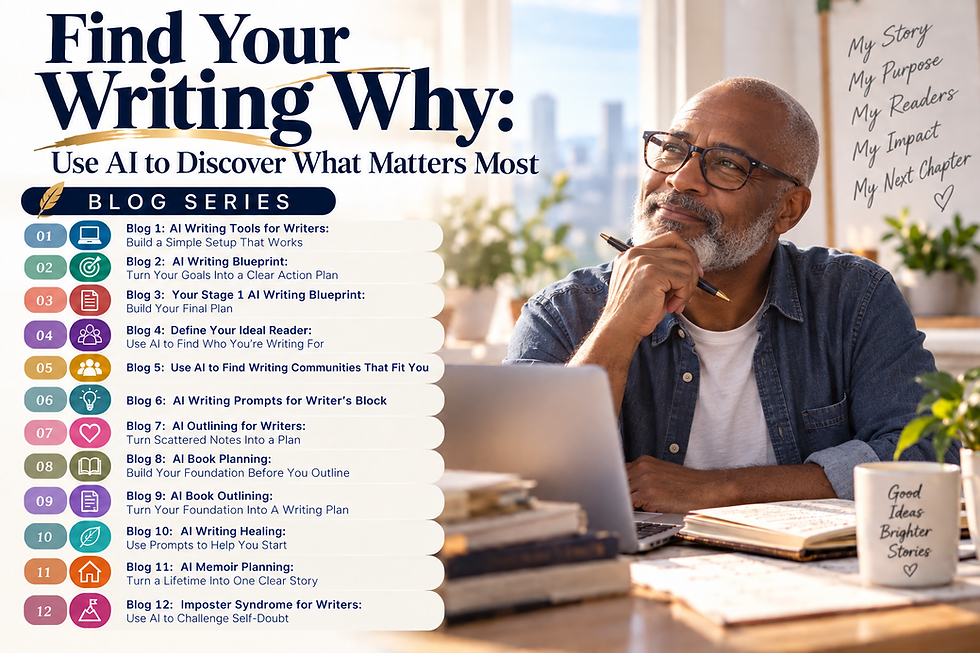
Use AI writing prompts to uncover your writing purpose, clarify your goals, understand your ideal reader, and create a stronger writing plan.
Why do you want to write? That sounds like a simple question, but it can be harder to answer than choosing a topic. You may know that you want to write a book, blog, poem, journal, family story, or guide. You may even have pages of notes. But if you do not understand what is pulling you toward the project, it can be easy to lose direction when the work gets hard.
Your writing why is the reason behind the words. It is what you hope the writing will do for you, for another person, or for a group of readers. One writer may want to preserve family memories. Another may want to teach something they learned the hard way. Someone else may want to entertain, build a business, leave a legacy, heal through reflection, or help one person feel less alone.
Artificial intelligence can help you explore those reasons, but it should not choose them for you.
Your values, memories, goals, and life experiences belong to you. In this article, we will use AI as an interviewer that asks better questions so you can discover what matters most before you build the rest of your writing plan.
This article is part of our growing AI for Writing series and supports the Dream stage of our Comprehensive 12 Steps for Writing. Stage 1 is where you begin thinking about what you want to write, why you want to write it, who it is for, and what you hope to accomplish.
What Does It Mean to Find Your Writing Why?
To find your writing why, you need to go one step deeper than the type of project you want to create. Saying, “I want to write a memoir” tells you what you want to make. It does not yet explain why that memoir matters to you.
The why might be, “I want my grandchildren to know what our family lived through.” It might be, “I want another person going through divorce to know that starting over is possible.” It might be, “I have taught this skill for years, and I want to put what I know into a book people can use.”
Those answers give the project direction.
Purdue University’s Online Writing Lab encourages writers to ask about purpose and audience before they begin writing. George Mason University’s Writing Center gives similar advice when using AI: the more clearly you understand your purpose, audience, and type of writing, the better your prompt can be. That means your why is not just an emotional idea. It can help you make practical writing choices too.
Why Your Writing Why Matters When Motivation Drops
Starting a writing project can feel exciting. Finishing one can take weeks, months, or years.
Somewhere in the middle, there may be days when you are tired, busy, unsure, or disappointed with what you wrote. A strong reason for writing can help you remember why the work deserves another day.
Your why also helps you decide what belongs in the project. If your goal is to help a beginner understand a hard subject, you may choose simple explanations and more examples. If your goal is to record family history, names, places, dates, and memories may matter more. If your goal is to entertain, pacing, characters, humor, suspense, or emotion may move higher on the list.
Clear goals can also make a large project feel more manageable. Purdue Writing Lab materials on goal setting recommend breaking a large writing objective into smaller goals. Before you can break down the work, though, it helps to know what the larger goal is supposed to accomplish.
How to Find Your Writing Why with AI
AI can be useful here because it can keep asking questions. Instead of giving the AI one prompt and asking it to tell you your purpose, ask it to interview you. This keeps the important thinking in your hands.
George Mason University’s Writing Center specifically recommends prompting AI chatbots to ask writers questions rather than simply giving suggestions or answers. That is exactly how we want to use AI in this stage. The AI can notice patterns in what you say, repeat your ideas back to you, and ask where you want to go deeper. You decide which answers are true.
For example, you might begin with: “I think I want to write about caring for my father, but I do not know what the real purpose of the story is. Ask me one question at a time. Help me explore who I want to reach, what I learned, what I hope a reader feels or understands, and what I would regret leaving unsaid. Do not decide my purpose for me.”
That kind of prompt does something important. It gives AI a job, but it keeps ownership of the story with the writer.
Four Common Kinds of Writing Why
Your reason may fit more than one category, and that is fine. These are not rules. They are simply starting points that can help you notice what is driving you.
To preserve: You want to save memories, family history, lessons, culture, traditions, or experiences that could otherwise be lost.
To help or teach: You want to explain a skill, share practical knowledge, warn others about mistakes, or make a hard path easier for someone else.
To express or understand: You want to work through thoughts, feelings, change, grief, growth, faith, identity, or a major life experience.
To create or build: You want to entertain readers, grow an audience, support a career, build a business, publish books, or create something that did not exist before.
A project can hold several reasons at once. A memoir may preserve family history, help readers, and support a speaking career. A poetry book may express emotion while also becoming something you want to sell. What matters is knowing which reason is most important when two goals compete.
Go Deeper Than the First Answer
The first answer to “Why do you want to write this?” is often true, but it may not be the whole answer. If you say, “I want to help people,” ask yourself what kind of help you mean. Do you want them to feel understood? Avoid a mistake? Learn a skill? Make a decision? Laugh during a hard season? Believe change is possible?
AI can help by asking follow-up questions. One useful technique is to tell it not to move on too quickly. Ask it to question each answer until you reach something specific enough that you can picture the reader or the result.
You may discover that what started as “I want to write a book about leadership” becomes “I want to help first-time supervisors stop repeating the harsh management style they experienced.” That second statement gives you much more guidance. It tells you who the reader may be, what problem matters, and what change you hope the book creates.
Turn Your Why Into a Simple Writing Goal
Once you have explored your deeper reason, turn it into a short sentence you can keep near your writing space. It does not need to sound impressive. It needs to be useful.
Try this formula: “I am writing this [type of project] for [reader] so they can [result], because [reason this matters to me].”
For example: “I am writing this family history for my children and grandchildren so they know where we came from, because many of our stories were never written down.” Another writer might say, “I am writing this beginner guide for people who feel overwhelmed by budgeting so they can make a simple plan without feeling ashamed.”
This sentence can change later. Writing often teaches us what we were really trying to say. The goal is not to lock yourself into one statement forever. The goal is to give yourself a clear starting direction.
Let Your Why Help You Make Decisions
A clear writing why becomes a filter. When you are unsure about a chapter, story, example, or side topic, ask whether it supports the purpose. If it does, keep working with it. If it does not, save it for another project instead of forcing it into this one.
Your why can also help you decide how much time and money to invest. A private journal written for healing has different needs from a book you plan to publish and market. A family memoir printed for twenty relatives may not need the same editing, cover design, or sales plan as a commercial memoir meant for bookstores.
This is why finding your why belongs early in the writing process. It affects later choices about audience, genre, research, schedule, editing, publishing, and marketing.
122
What AI Should Not Decide for You
AI can organize answers and suggest questions, but it cannot know what matters most in your life unless you tell it. It does not carry your memories, relationships, grief, humor, faith, regrets, hopes, or responsibilities. Those are human parts of the writing process.
Your existing Surviving Life Lessons AI writing guidance already makes an important point: set clear goals, use AI for inspiration, keep your voice, and review what the tool gives you. AI is there to support your creativity, not replace it.
Also remember that AI can make mistakes. The National Institute of Standards and Technology has documented risks unique to generative AI, including the possibility of inaccurate or misleading output. If your project includes facts, research, dates, medical information, statistics, quotes, or historical details, verify them with reliable sources instead of assuming an AI answer is correct.
When Your Writing Why Changes
You are allowed to change your reason. A project may begin as something private and later become something you want to share. A book meant to teach may become more personal as you realize readers need your story as much as they need your advice.
Revisit your why at major points in the project. Ask yourself whether the original purpose still fits. If not, write a new statement. A changing purpose does not mean you failed. It can mean the writing helped you understand the project better.
Writing Suggestions to Help You Find Your Why
Before opening an AI tool, spend a few minutes answering these questions in your own words.
Handwriting them can be especially useful because it gives you time to think before a tool responds.
What do I keep thinking about writing, even when I am busy with other things?
Who do I imagine reading this one day?
What do I want that person to feel, know, understand, remember, or do after reading it?
What have I lived, learned, noticed, researched, or created that I do not want to leave unsaid?
If I never finished this project, what would I regret not sharing?
What part of this project is for me, and what part is for the reader?
What would success look like even if the project never became a bestseller?
AI Prompt Suggestions: Use AI to Discover Your Writing Why
The best prompts in this stage ask AI to help you think. Copy one of these, answer honestly, and change the wording so it fits your project.
I want to write about [topic], but I am not sure why this project matters so much to me. Interview me one question at a time. Do not tell me my purpose. Help me discover it from my own answers.
Ask me ten questions that explore what I hope a reader will feel, learn, understand, remember, or do after reading my work. Do not write the project for me.
I will tell you why I think I want to write this project. Ask follow-up questions that help me go deeper than my first answer. Stop after each question so I can respond.
Help me separate my personal reasons for writing this project from my goals for the reader. Use only the information I give you.
Ask me questions that help me identify the one reader I most want to reach. Then help me explain why reaching that person matters to me.
Here are my reasons for writing this project: [paste reasons]. Group them into themes, but do not add reasons I did not give you. Ask me which theme feels most important.
Help me complete this sentence using my own answers: I am writing this [project] for [reader] so they can [result], because [why it matters to me]. Ask questions instead of filling in the blanks for me.
I have two possible reasons for writing this project: [reason one] and [reason two]. Ask questions that help me decide which should guide the project when the two goals conflict.
Act as a writing coach. Ask me what I would regret leaving unsaid if I never finished this project. Then ask gentle follow-up questions to help me make the answer more specific.
Read my writing-purpose statement and tell me what is clear and what is still vague. Do not rewrite it. Ask me three questions that would help me strengthen it in my own words.
Free and Paid Writing Resources You Can Explore
You do not need expensive software to discover your writing purpose. A notebook, phone notes app, voice recorder, or free document can be enough. Many AI chat tools also offer free access levels, although features and limits can change.
Paid tools may become useful later when you are drafting, revising, organizing a large manuscript, or preparing work for publication. Programs such as Grammarly, ProWritingAid, and Scrivener can support different parts of the process. The right tool depends on what you are writing and where you are in the project.

You can explore more writing stages, questions, and tools in our Comprehensive 12 Steps for Writing.
Take the Next Step with Other Writers
AI can ask useful questions, but another writer may hear something in your answer that a computer cannot fully understand. Talking with people who are also trying to write can help you test your purpose, explain your ideas, and stay connected to the human side of storytelling.
Visit the Surviving Life Lessons Groups section to explore opportunities to connect, learn, and keep moving forward with others.
Your why does not have to be dramatic. It only has to be true enough to guide you. AI can help you ask the questions. The answers that shape the story should still come from you.
Your Story Matters
We need your nice comments below! Your thoughts, experiences, and lessons learned might be exactly what someone else needs to hear today.
Drop a comment, Say Hello, and join the conversation.
Need More Personalized Support?
Everyone's journey is unique. If you're looking for personalized guidance, encouragement, or one-on-one support, explore our services to find the option that's right for you. We're here to help you take your next step with confidence and hope.
Helpful Resources for Your Journey
Explore our collection of books, journals, coloring books, and printable PDFs designed to encourage, inspire, and support you every step of the way.
References
George Mason University Writing Center: "Write a Prompt for Gen AI", https://writingcenter.gmu.edu/writing-resources/gen-ai-and-writing/write-a-prompt-for-gen-ai
George Mason University Writing Center: "Using Gen AI in Your Writing Process", https://writingcenter.gmu.edu/writing-resources/gen-ai-and-writing/using-gen-ai-in-your-writing-process
Purdue Online Writing Lab: "The Writing Process", https://owl.purdue.edu/owl/resources/teaching_resources/documents/the-writing-process-20250724.pdf
Purdue Writing Lab: "Setting Goals & Staying Motivated - Vidcast Transcript", https://owl.purdue.edu/owl/graduate_writing/documents/IWE_2020_Goal%20Setting_Transcript.pdf
National Institute of Standards and Technology: "Artificial Intelligence Risk Management Framework: Generative Artificial Intelligence Profile", https://www.nist.gov/publications/artificial-intelligence-risk-management-framework-generative-artificial-intelligence
About the Author:
Deborah Ann Martin is the founder of Surviving Life Lessons, a published author, poet, speaker, and trainer with over 20 years of management experience across multiple industries. An MBA graduate, U.S. veteran, single mother, and rare cancer survivor, Deborah brings both professional expertise and lived experience to her writing on resilience, leadership, personal growth, and overcoming adversity. Her mission is to empower others with practical wisdom and real-life insight to navigate life’s challenges with strength and purpose.



.png)
Comments