

AI Learning Plan for Writers: What to Learn Before You Write

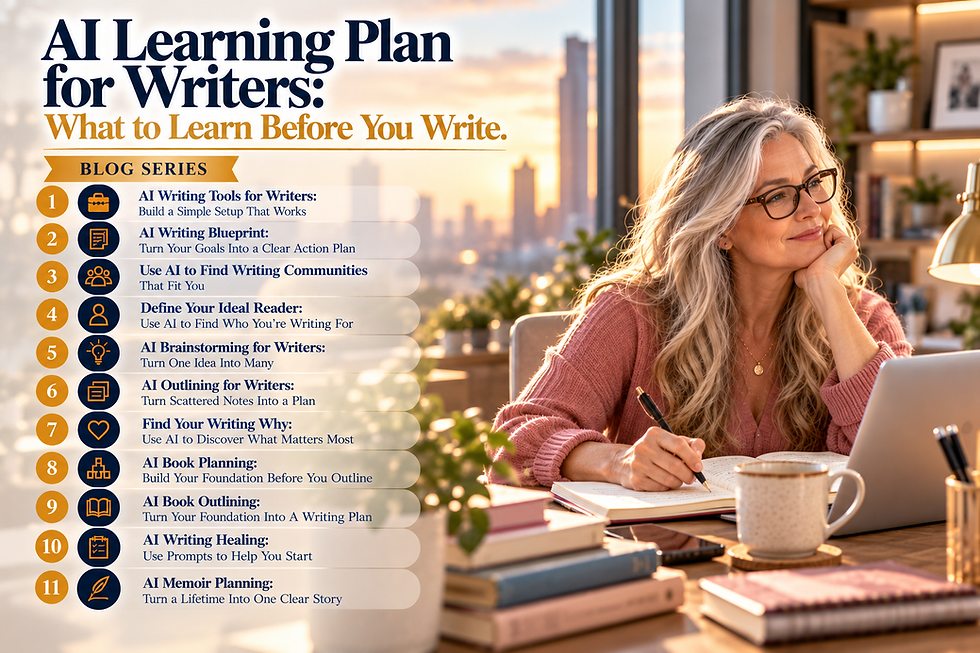
AI Learning Plan for Writers Helps You Learn Without Losing Writing Time
There is a point in almost every writing project when you realize you do not know everything you need to know yet. That is normal. A new fiction writer may need to learn point of view, scene structure, or dialogue. A memoir writer may need to think about memory, privacy, and how to shape a life story. A nonfiction writer may need stronger research, citation, or interview skills. A children’s writer may need to learn age ranges, reading levels, page expectations, and how pictures and words work together.
The problem is not that writers need to learn. The problem is that learning can become so large that it takes over the writing. One podcast leads to another. One YouTube video leads to twenty more. A course recommends three books. A social media post says you must learn a completely different method. Before long, you have spent weeks collecting advice but have not moved any closer to the project you wanted to create.
An AI learning plan for writers can help organize this part of Stage 1. AI can interview you about your project, help identify likely skill gaps, sort those gaps by priority, suggest types of resources to look for, and turn the results into a short learning plan. The goal is not to let AI become your teacher for everything. The goal is to use AI as an organizer so you spend less time searching and more time learning what actually matters.
That fits the larger purpose of this series. AI should help with the planning, sorting, questioning, and repetitive work around writing so you have more time and energy for the creative work only you can do.
Start Your AI Learning Plan for Writers With the Project, Not the Internet
A good learning plan begins with the writing project in front of you. It does not begin with a giant list of famous books, writing influencers, or popular courses. Purdue University’s writing-process guidance begins with questions about purpose, audience, genre, tone, and research needs. Those questions matter because the skills you need depend on what you are trying to create.
Someone planning a family legacy memoir does not need the same learning plan as someone writing a commercial fantasy series. A poet preparing a collection does not need the same resources as a blogger building a business. Even two novelists may need very different help if one struggles with plot and the other already plots well but needs to learn dialogue.
Before asking AI what you should study, give it a clear picture of the project. Tell it the type of writing, intended reader, genre or subgenre, your experience level, what you already know, what makes you nervous, and what you hope to accomplish. The more specific you are, the less likely you are to receive a generic list of writing advice.
Use AI to Find Your Skill Gaps Before It Finds Resources
This is the most important step in the article. Do not begin by asking, “What are the best books for writers?” That question is too broad. Ask AI to help you discover what you need to learn first.
Act as a learning-plan interviewer for a writer. Do not write my project for me. Ask me one question at a time about what I am writing, my intended reader, genre, experience, strengths, concerns, and what I already know. After I answer, create a skill-gap list. Separate what I probably need to understand before drafting, what I can learn while drafting, and what can wait until later. Explain why each item is in that category.
That prompt changes AI from a recommendation machine into a planning partner. It makes the writer’s needs come first.
Possible Skill Areas AI Can Help You Check
Genre and subgenre expectations
Intended audience and age group
Point of view and narration
Plot, scene, chapter, or section structure
Character development
Dialogue
World-building or setting
Memoir structure and life-story boundaries
Poetry forms, collection structure, and revision
Nonfiction research and source evaluation
Interviewing and note-taking
Citations, permissions, and attribution
Writing for children and age-appropriate language
Blog writing, search intent, and online readability
Grammar or sentence-level skills
Writing software or organization tools
Giving and receiving feedback
Basic publishing or author-business knowledge that may affect early planning
You do not need to master every item on this list. That would defeat the purpose. The goal is to find the few things that could cause major problems if you begin without understanding them.
Sort Learning Into Three Buckets
Once AI helps identify possible skill gaps, sort them into three buckets. This keeps preparation useful instead of endless.
1. Need Before Writing
These are things that affect the foundation of the project. If you are writing for young children, age range and format belong here. If you are writing a mystery, you may need a basic understanding of how clues and reveals work before building the outline. If you are writing researched nonfiction, you may need a source and citation system before gathering hundreds of notes.
2. Learn While Writing
These are skills you can improve as they appear. You may not need a full course on dialogue before drafting Chapter 1. You might learn enough to begin, write several scenes, then study dialogue more deeply when you can apply the lesson immediately. Learning attached to a real writing problem often feels more useful than learning everything in advance.
3. Save for Later
Some information is valuable but not urgent. Marketing, launch strategy, advanced formatting, advertising, or detailed business systems may matter later, but they should not keep you from starting the manuscript if they do not affect the work you need to create now.
AI can help you sort the list, but you make the final decision. If something feels important to your project, move it. The categories are tools, not rules.
Ask AI for Types of Resources Before Specific Recommendations
The next step is finding the best way to learn each skill. Different problems call for different resources. A short video may be enough to explain a concept. A detailed craft book may be better for something complex. A podcast can help you hear several writers discuss how they approach the same problem. A workshop may be useful when you need practice and feedback.
Ask AI to match the learning method to the goal before asking for names. For example, if you need to understand point of view, AI might suggest a short university guide for the basic definition, a craft book for deeper study, a lecture for examples, and a writing exercise for practice. That is more useful than receiving twenty random links.
For each skill on my Need Before Writing list, recommend the best type of learning resource first: university guide, professional organization, craft book, podcast, YouTube lecture, course, workshop, or writing exercise. Explain why that format fits the skill. Then give me no more than three specific resources to investigate. Do not invent titles, authors, organizations, links, or credentials. If you are not sure a resource exists or is current, say that I need to verify it.
Use AI to Find Better Writing Books Without Buying a Library First
Writing books can be extremely useful because they let an experienced writer or teacher go deeper than a short post or video. But buying every recommended writing book can become expensive and overwhelming.
Use AI to narrow the field. Ask for books that address one specific need and match your current experience. A beginner may need a clear introduction. An experienced writer may need a specialized book on scene tension, memoir structure, research, poetry revision, or writing for a particular age group.
Then verify the book yourself. Look at the author’s background, publisher, publication date, table of contents, library availability, and reviews from readers who actually write in your area. Your public library can be one of the best free writing resources available. Many libraries provide print books, ebooks, audiobooks, databases, workshops, and sometimes access to online learning platforms.
Use AI to Find Writing Podcasts That Match Your Current Problem
Podcasts are useful when you want to learn while driving, walking, cooking, or doing other tasks. They are also useful for hearing several writers explain how they make decisions. The weakness is that podcast archives can be huge. Searching hundreds of episodes takes time.
This is a good job for AI. Instead of asking for “good writing podcasts,” tell AI your problem and ask for podcasts that regularly cover it. Then ask for current official websites or episode indexes so you can search those sources directly.
Writing Excuses is one example of a long-running educational podcast created for writers. Its official site describes the show as “tools, not rules” and says it is designed to help writers improve their craft. That makes it useful as an example of the kind of resource a writer can investigate. It does not mean every episode applies to every project.
I am learning [specific skill]. Find up to three established writing podcasts that regularly discuss this subject. Give me the official podcast website, the type of writer it serves, and what I should search for in its episode archive. Do not invent episode titles. If you cannot verify an episode, tell me what search words to use on the official site.
Use AI to Find Better YouTube Writing Lessons
YouTube can be an excellent classroom and a terrible time trap. Anyone can post writing advice, so popularity should not be confused with expertise. A video with a million views may still be one person’s method rather than a rule everyone must follow.
Ask AI to favor lectures from universities, professional organizations, working writers with clear experience in the subject, editors, agents speaking within their area of expertise, or established writing programs. Then check the channel and description yourself.
For fiction writers, Brandon Sanderson’s recorded creative-writing lectures from Brigham Young University are an example of a free lecture series available on YouTube. They focus heavily on science fiction and fantasy, so they are not a universal writing course. That limitation is part of good resource selection. A strong resource is not simply “good.” It is good for a particular person, project, and question.
Use AI to Find Courses, Workshops, and Webinars Without Overspending
Paid learning can be useful, but price does not guarantee quality. Before buying a course, ask what problem it solves that you cannot solve with a book, free guide, library resource, writing group, or short workshop.
Professional organizations can be a good place to look because many offer educational events tied to the writing profession. The Authors Guild currently maintains a resource library and educational events for writers at different stages and in different areas of writing. Genre-specific organizations may offer even more focused training.
Use AI to compare courses by instructor background, curriculum, project fit, level, feedback opportunities, time commitment, price, refund policy, and whether the course produces something you can apply to your current work. Never let AI turn marketing language into proof that a course is right for you.
University Writing Centers Can Be Part of Your Free Learning Plan
Writers sometimes assume university writing centers are useful only for students writing essays. Many university writing centers publish free guides on brainstorming, outlining, audience, revision, organization, grammar, research, and other skills that apply much more broadly.
George Mason University’s Writing Center, for example, maintains free quick guides covering the writing process and different genres. Purdue OWL also provides widely used writing resources. These are useful starting points when you need a clear explanation of a writing concept before moving to a specialized book, course, or professional resource.
If you are currently a student, remember that your school may have specific rules about AI use. George Mason’s current guidance tells students to follow the instructor’s policy and to engage critically with AI output. That is a good reminder even outside school: AI should support learning, not replace it.
Teach AI How You Want Resources Evaluated
AI can make a list quickly. That does not mean the list is trustworthy. The National Institute of Standards and Technology warns that generative AI can confidently produce false information, including false citations. George Mason’s AI guidance also warns writers to check fabricated sources, links, quotations, facts, and data.
So give AI evaluation rules. Ask it to tell you why a resource may be useful and what you still need to verify. You can also use a simple source check inspired by university library guidance.
Authority: Who created the resource, and what experience or expertise do they have?
Purpose: Is the goal to teach, sell, entertain, recruit, or promote a product?
Relevance: Does it address the exact skill and type of writing you are working on?
Currency: Does the information need to be current, and if so, when was it updated?
Evidence: Does the source explain where factual claims or rules come from?
Perspective: Is this presented as one writer’s method, a common convention, professional guidance, or a formal requirement?
Verification: Can important claims be confirmed through another trustworthy source?
Cornell University Library encourages researchers to critically analyze sources and independently verify information rather than accepting a search result simply because it appears first. That is an excellent habit for writers using AI to find learning resources.
Do Not Let AI Invent the Perfect Resource
This deserves its own warning because invented resources can look very convincing. AI may generate a realistic book title, a believable podcast episode, a course that sounds perfect, or a link that looks official even when the item does not exist.
If a resource matters to your plan, open the official website, publisher page, library catalog, podcast site, university page, or professional organization page. Verify the name, creator, description, and current availability yourself. When possible, ask AI to give you the official source rather than a summary copied from another site.
This small verification step protects both your time and your money.
Build a Short Resource List, Not a Resource Warehouse
A resource list becomes less useful when it is too large. If your goal is to understand memoir structure, you probably do not need twelve books, nine podcasts, four courses, and eighty saved videos before writing a page.
A better starting rule is one strong introductory resource, one deeper resource, and one practice resource for each important skill gap. You can always add more if the problem remains.
Choose one skill you need before drafting.
Choose one free explanation to learn the basics.
Choose one deeper resource if the skill needs more study.
Choose one exercise or small action that lets you practice it.
Apply what you learned to your own project.
Only add another resource if you can name what is still unclear.
That last step is important. Do not keep consuming advice simply because more advice is available.
Use AI to Build a Two-Week or 30-Day Learning Plan
Once the resource list is small, AI can turn it into a realistic schedule. This is where Article #5 on the 30-day writing schedule connects to this new learning plan. Your schedule does not need to stop writing while you learn. Learning and writing can overlap.
For example, a writer might spend two short sessions learning about point of view, then write a scene using what they learned. The next week they might study scene goals and revise that same scene. This keeps learning attached to the real project.
Here are the skills I need before drafting, the resources I chose, and the amount of time I can realistically spend each week. Build a two-week learning plan that keeps at least half of my available writing time protected for my own creative work. Give me one learning task and one application task for each session. Do not add more resources unless I ask.
Different Writing Projects Need Different AI Learning Plans
Fiction Writers
A fiction writer may need to study point of view, scene structure, character goals, conflict, pacing, dialogue, genre expectations, or world-building. The learning plan should focus on the weak spots that affect the current story, not every fiction technique ever taught.
Memoir and Personal Story Writers
A memoir writer may need to learn the difference between memoir and autobiography, how to choose a central thread, how to handle time, how to write scenes from memory, how to research missing details, and what privacy or legal questions should be discussed with a qualified professional when real people are involved.
Nonfiction Writers
A nonfiction writer may need research methods, source evaluation, note organization, interviewing, citations, permissions, reader level, chapter structure, or methods for explaining difficult ideas clearly. Writers dealing with medical, legal, financial, or other high-stakes subjects may also need expert review.
Children’s Writers
A children’s writer may need to study age categories, reader development, vocabulary, page and illustration relationships, read-aloud quality, school or parent buyers, genre expectations, and the difference between the child who reads the book and the adult who may purchase it.
Poets
A poet may want to study forms, sound, line breaks, imagery, revision, ordering a collection, performance, or submission practices. A learning plan can still be highly structured without turning the poems themselves into formula.
Blog and Online Writers
A blog writer may need to learn audience needs, search intent, headings, readability, sourcing, internal linking, accessibility, and basic SEO. The learning plan should support the real reader first, not turn the writing into a collection of keywords.
Protect Your Creative Energy From Endless Learning
Learning feels productive because it is productive. That is why it can be difficult to notice when it becomes avoidance. You can spend an entire year preparing to write a book and still feel that you need one more course before you are ready.
Build a stopping rule into the plan. For example: “I will study these three topics for two weeks, then begin the outline,” or “I will complete one beginner resource on picture books, then draft my first version and learn the next skill from the problems I find.”
AI can remind you of the stopping rule. It should not keep expanding the curriculum every time you ask another question.
Know When You Have Learned Enough to Begin
You do not need to feel like an expert before you write. You need enough knowledge to make informed early decisions and enough humility to keep learning as the project develops.
A strong Stage 1 learning plan should leave you with fewer questions than you started with, not hundreds more. You should know what matters now, what can wait, where you can go for trustworthy help, and how much time you are willing to spend learning before returning to your own words.
The goal is not to become a professional student of writing advice. The goal is to become a writer who knows how to learn what the work requires.
10 AI Prompts to Build Your Writer Learning Plan
Interview me one question at a time about my writing project, experience, strengths, and concerns. Then identify the five most important skills I may need before I begin drafting. Do not write the project for me.
Here is my project description. Separate possible learning needs into Need Before Writing, Learn While Writing, and Save for Later. Explain your reasoning and let me move items between categories.
For this skill gap, tell me what I should understand at a beginner level before I start writing. Give me a short checklist of concepts, not a lesson or a draft.
Recommend the best type of resource for learning this skill: book, university guide, podcast, YouTube lecture, course, workshop, professional organization, or writing exercise. Explain why.
Find up to three resources for learning this skill. Prefer official university, professional organization, publisher, creator, or established program pages. Do not invent titles, links, credentials, or episode names. Tell me what I should verify myself.
Compare these three writing resources for my project. Use the criteria: experience level, genre fit, depth, cost, time needed, practical exercises, and how quickly I can apply the lesson.
I have collected this list of writing resources. Help me remove duplicates and anything that does not directly support my current project. Keep the smallest useful list.
Build a two-week learning plan from these resources. Protect at least half of my available time for my own writing. Pair each learning task with a small application task.
I have been researching writing for several weeks. Ask me five questions to determine whether I am still learning something necessary or using preparation to avoid beginning.
Create a simple learning log with columns for skill, resource, one lesson I learned, how I applied it, what is still unclear, and whether I need another resource.
Writing Suggestions
Before opening a new video, podcast, course, or book, write down the one question you want that resource to answer. When you finish, write down one thing you will apply to your own project. This turns learning into action.
Write a list titled “What I Already Know.” Writers often underestimate how much experience they already have.
Write a second list titled “What Could Stop This Project Later If I Ignore It Now?” Those items are strong candidates for Need Before Writing.
Choose one skill gap and spend 20 minutes finding one trustworthy starting resource rather than collecting ten.
After every learning session, write or revise something small in your own project so the lesson becomes practice.
At the end of each week, remove resources you no longer need. A shorter list is often a sign of clearer thinking.
Free and Paid Resources and Tools
Free Resources
George Mason University Writing Center Quick Guides: free guides on writing process, genres, research, revision, and GenAI.
Purdue OWL: free writing-process, research, grammar, citation, and rhetorical resources.
Cornell University Library research guides: useful for learning how to evaluate information and sources.
Writing Excuses: a free educational writing podcast with a large craft archive.
Brandon Sanderson’s BYU creative-writing lectures on YouTube: a free fiction-focused lecture series, especially relevant to science fiction and fantasy.
Public libraries: books, ebooks, audiobooks, databases, local programs, and sometimes online learning access.
Paid Resources
Craft books that address one specific skill you need.
Workshops and classes from established writing centers, universities, libraries, or professional writing organizations.
Genre-specific professional memberships that include education, events, resources, or community.
Authors Guild membership and educational programs for writers who need professional and business guidance.
One-on-one coaching or instruction when you have a specific problem that general resources are not solving.
Try free resources first when they can answer the question. Pay when the paid option gives you something important that free material does not, such as expert feedback, a structured curriculum, specialized knowledge, accountability, or access to a professional community.
Continue the Conversation in Our Writing Groups
Learning becomes more useful when you can talk about what you are discovering with other writers. Visit the Writing Groups in the Groups section of Surviving Life Lessons to share resources, ask what helped other writers, compare learning plans, and talk about what you are preparing to write. A community can also help you recognize when you have learned enough and it is time to begin.
Stage 1 is about preparing the ground. AI can help you decide what to learn, sort the information, narrow the resources, and build the plan. Your time and creative energy can then go back where they belong: into the writing you care about.

Want the full writing roadmap? Read The 12 Stages Every Writer Should Know.
Your Story Matters
We need your nice comments below! Your thoughts, experiences, and lessons learned might be exactly what someone else needs to hear today.
Drop a comment, Say Hello, and join the conversation.
Need More Personalized Support?
Everyone's journey is unique. If you're looking for personalized guidance, encouragement, or one-on-one support, explore our services to find the option that's right for you. We're here to help you take your next step with confidence and hope.
Helpful Resources for Your Journey
Explore our collection of books, journals, coloring books, and printable PDFs designed to encourage, inspire, and support you every step of the way.
References
George Mason University Writing Center: "Writing Center Quick Guides", https://writingcenter.gmu.edu/writing-resources
George Mason University Writing Center: "Using Gen AI in Your Writing Process", https://writingcenter.gmu.edu/writing-resources/gen-ai-and-writing/using-gen-ai-in-your-writing-process
George Mason University Writing Center: "Write a Prompt for Gen AI", https://writingcenter.gmu.edu/writing-resources/gen-ai-and-writing/write-a-prompt-for-gen-ai
Purdue Online Writing Lab: "The Writing Process", https://owl.purdue.edu/owl/resources/teaching_resources/documents/the-writing-process-20250724.pdf
Cornell University Library: "Evaluate Sources", https://guides.library.cornell.edu/english1183ac23/evaluate
National Institute of Standards and Technology: "Artificial Intelligence Risk Management Framework: Generative Artificial Intelligence Profile", https://www.nist.gov/publications/artificial-intelligence-risk-management-framework-generative-artificial-intelligence
The Authors Guild: "Resource Library", https://authorsguild.org/resources/
Writing Excuses: "Home", https://writingexcuses.com/
Brandon Sanderson. “Lecture #1: "Introduction — Brandon Sanderson on Writing Science Fiction and Fantasy. YouTube", https://www.youtube.com/watch?v=-6HOdHEeosc
About the Author:
Deborah Ann Martin is the founder of Surviving Life Lessons, a published author, poet, speaker, and trainer with over 20 years of management experience across multiple industries. An MBA graduate, U.S. veteran, single mother, and rare cancer survivor, Deborah brings both professional expertise and lived experience to her writing on resilience, leadership, personal growth, and overcoming adversity. Her mission is to empower others with practical wisdom and real-life insight to navigate life’s challenges with strength and purpose.


.png)
Comments